

 |
| Paul Reuge, Fund Manager |
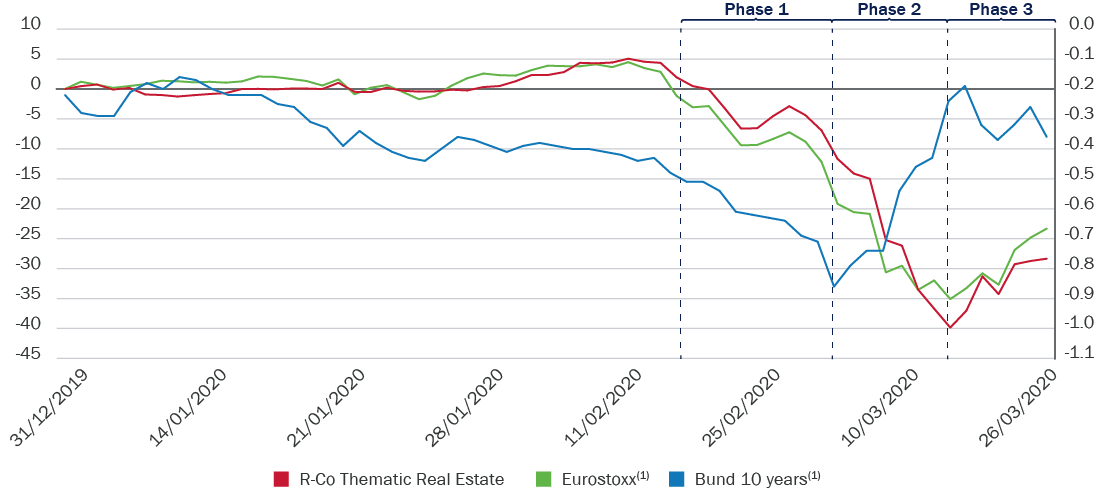
The (expected) reaction of the ECB, through the announcement of a massive sovereign debt purchase programme for the Eurozone countries, reversed the upward trend in long-term rates. Germany’s 10-year yield thus contracted by 16 basis points from its March 19 high, after expanding by more than 60 basis points from its March 9 reference point. In the wake of this announcement, the whole equity market recovered. Listed real estate did not particularly benefit from the fall in interest rates in this rebound but this may further bring back investors to real-estate stocks.
Performance of R-co Thematic Real Estate compared to the Eurostoxx and the 10-year Bund
Source: Bloomberg, Rothschild & Co Asset Management Europe, 31/03/2020. (1) Comparison Index
As regards companies, the “cash is king” formula once again became the main concern in their communication to reassure investors about their liquidity levels and their ability to meet future commitments. Some real estate companies have questioned their guidance waiting for greater visibility on the consequences of the crisis. For the most affected commercial property companies, the Rubicon has been crossed regarding dividends. Several of them, including the largest one Unibail Rodamco, have reduced or even withhold them (Deusche Euroshop). The irony is that these decisions were well-received by investors (momentary rebounds in share prices) whereas this would probably not have been the case prior to the crisis. It is likely that distribution levels will not return to normal once the calm is restored, due to the structural challenges facing the retail industry. For some, this crisis will have been a perfect “alibi” to reduce distribution levels in advance.
In this rebound, there is no symmetry in the phase 2: the sub-sectors that have increase the most are not those that have been the most impacted previously:
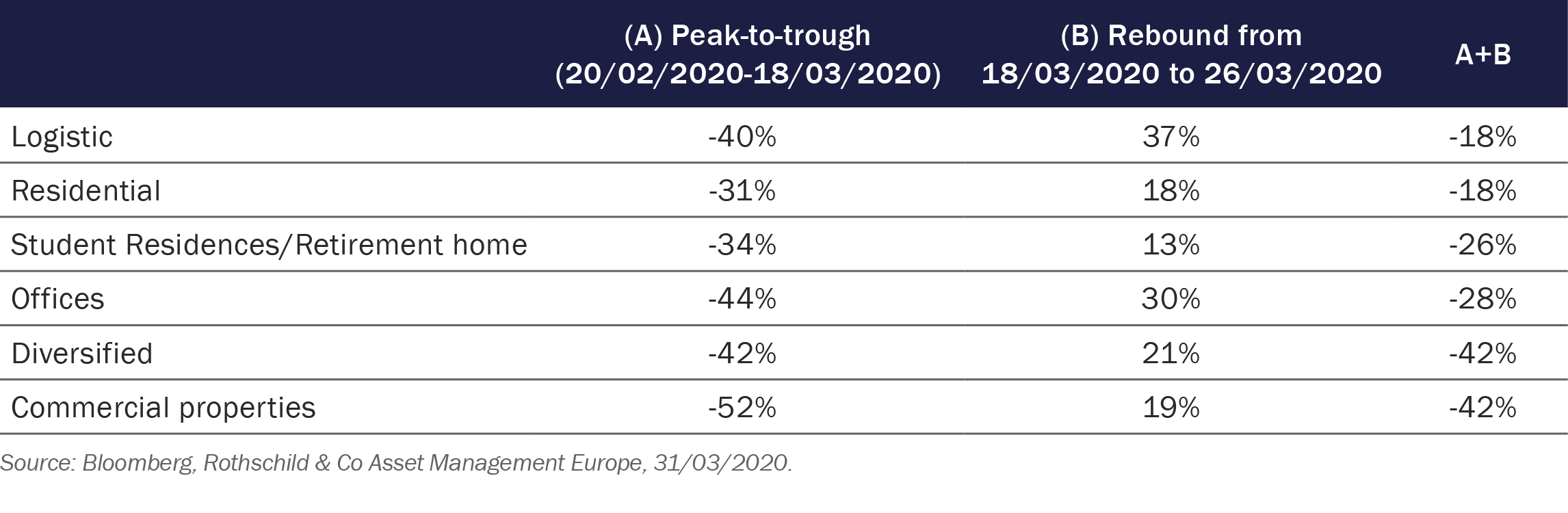
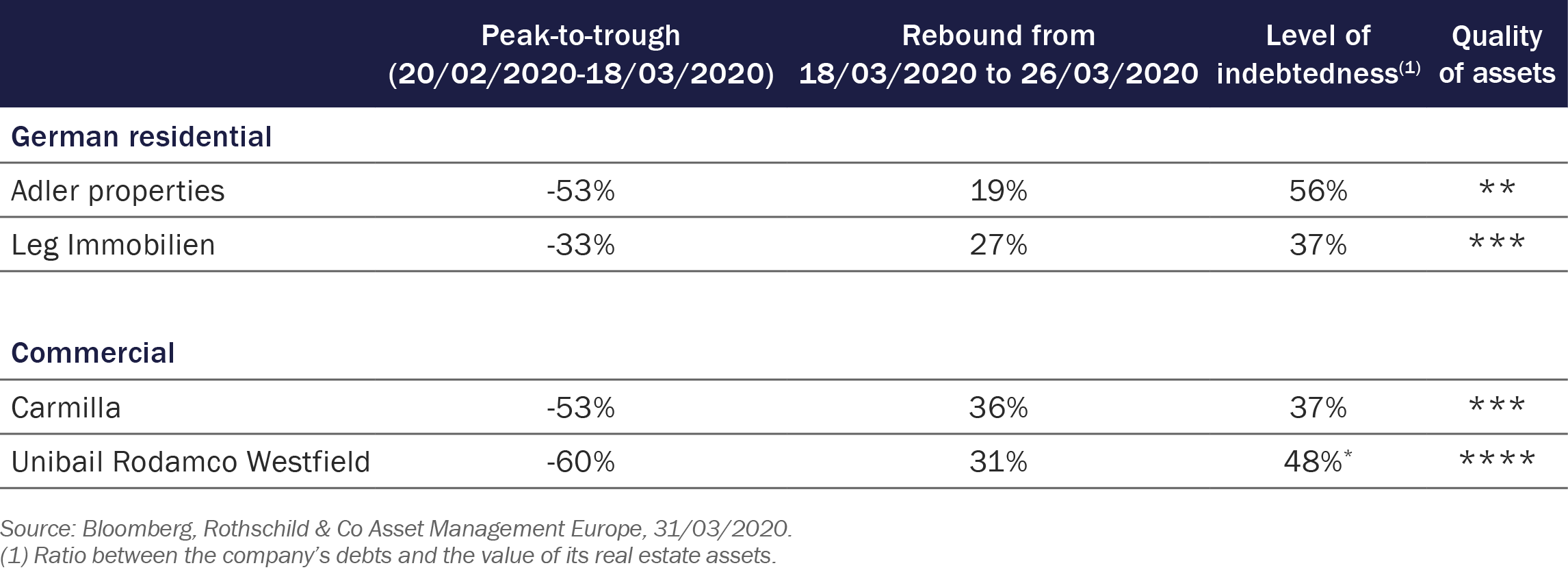
Moreover, within each category, a second condition was necessary to bounce back: presenting the least risk (both balance sheet and property assets) reflecting the “flight to quality” of investors.
As an example, here are the trends for few stocks:
While it is too early to have a precise idea of the consequences of the COVID-19 crisis on the economy and on real estate, this event has nevertheless called into question some management choices made at the end of 2019. The market downturn has enables stocks that have become too expensive to offer attractive entry points (German residential, logistics). Commercial real estate, which was already “value” before the crisis, probably sees the prospect of “re-rating” in the short/medium term disappearing in the face of a dual crisis, both structural (changing consumption patterns) and cyclical, likely to worsen the first one over the long term. For some of them, debt issues are added.
Against this backdrop, we have reduced our allocation to commercial stocks (-4.5%) and certain diversified stocks (-4.7%) to reallocate to German residential (+5.5%) and logistics (+2%).
Completed writing on 30 March 2020
For more information about the fund R-co Thematic Real Estate


