


Yoann Ignatiew y Charles-Edouard Bilbault
Co-Fund Managers of the fund R-co Valor
Portfolio allocation changed marginally during the quarter, mainly through intra-sector arbitrages. As a result, our exposure to equity markets remained essentially unchanged throughout the summer period, at around 72%.
The third quarter of 2019 was marked by the return of a multitude of uncertainties and a slowdown in the global economy, prompting Central banks to implement particularly accommodating monetary policy once again. Against this backdrop, investors are not currently expecting a short-term economic recovery at all but rather anticipating further rate cuts. This hypothesis is supported by the sluggishness of leading economic indicators. In the long run, this scenario could prove favourable to equity markets, but only if there is more visibility on the political and economic fronts. In addition, stock market indices are still at high levels, but a phenomenon of sector rotation in favour of defensive stocks tends to occur in a context in which the dollar keeps on strengthening.
Based on this analysis, we are adopting a relatively cautious approach with a rather defensive stance in terms of allocation while voluntarily maintaining exposure to certain specific sectoral risks. Our overall allocation is well below the levels reached at the beginning of the year or even below its historical average, due to profit taking in sectors that have performed well. However, we are still maintaining an equity exposure comparable to the previous quarter, around 72%, and continuing to initiate positions when we feel it is appropriate.
This near-stability has not prevented some changes within the portfolio. For instance, the industrial company Bombardier was introduced in July, then reinforced throughout the summer. At the end of August, profits were generated from gold mines through reductions in Barrick Gold and Pretium Resources, following the very good performance posted by the sector in recent months. Gold prices rose sharply from $1,300 to $1,500 per ounce, reflecting macroeconomic uncertainties and developments related to the trade war. The cash that was freed up was subsequently reinvested in two copper mining companies, Teck Resources and Ivanhoe Mines.
The quarter was also marked by the gradual introduction of the biotechnology company Biomarin, taking advantage of the reduction in Celgene, in line with the trades made on the stock following the M&A transaction led by Bristol-Myers Squibb, which it has been the subject of since the beginning of the year. Again, in the healthcare sector, we also slightly increased Fresenius at the beginning of September. We are nevertheless aware that this sector remains under pressure as US elections approach and with the recurrent debate on drug prices, currently exacerbated by the Democratic primaries. However, our outlook is based on a long-term vision and on structural issues, such as the ageing of the population, but also on the sector’s capacity for innovation.
As all these changes are the result of arbitrages within the portfolio, the fund’s exposure to equities remained stable at the end of the quarter. We therefore retain a significant amount of flexibility to be able to react and adjust our allocation if necessary. In addition, the next quarterly corporate results will be released in mid-October. While publications had surprised during the previous campaign, given the low or even negative expectations, forecasts for the upcoming season are not much more optimistic. This sentiment is exacerbated by a clear economic slowdown and reinforced by a series of political, geopolitical and macroeconomic risks. This uncertain environment warrants some caution and compels us to be patient until we have better visibility.
R-co Valor: Portfolio’s geographical and thematic breakdown as of September 2019
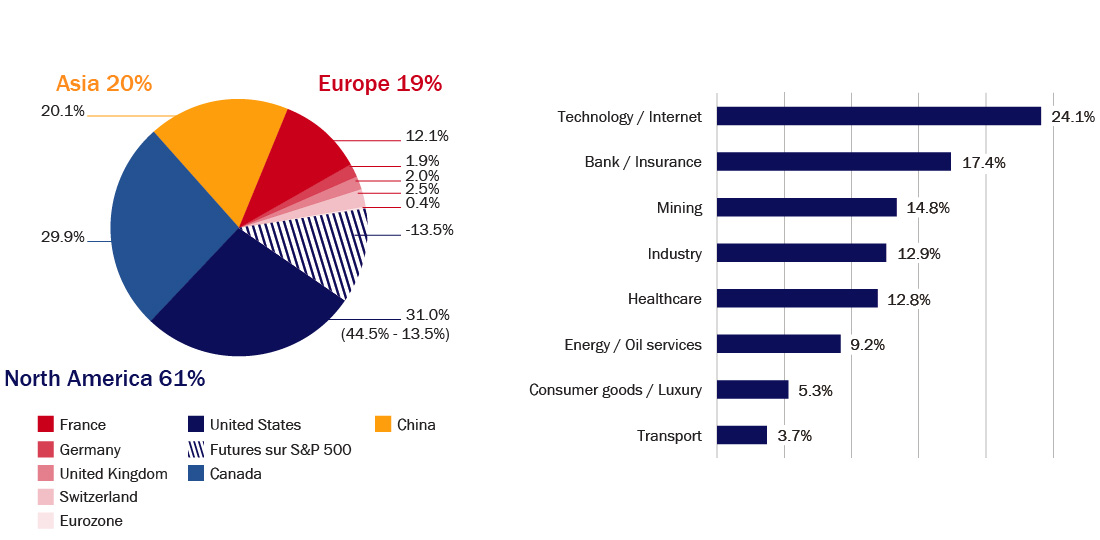
Source: Rothschild & Co Asset Management Europe, 30/09/2019
The features of the portfolio are not fixed and may vary over time.
R-co Valor Balanced

Yoann Ignatiew and Emmanuel Petit
Co-fund manager and co-fund manager & Head of Fixed-Income
Portfolio Allocation
The equity pocket represents just over 35% of the allocation while bonds account for 43.5% of the portfolio. The balance corresponds to the available cash.
On the stock markets, the allocation is intended to be substantially similar to that of R-co Valor, giving priority to North America. China and Europe are both around 20%. In sectoral terms, the segment is mainly invested in growth stocks from the technology, financial and commodities sectors as well as in the industrial, healthcare and energy sectors.
R-co Valor Balanced: Geographical and thematic breakdown of the Equity pocket as of September 2019
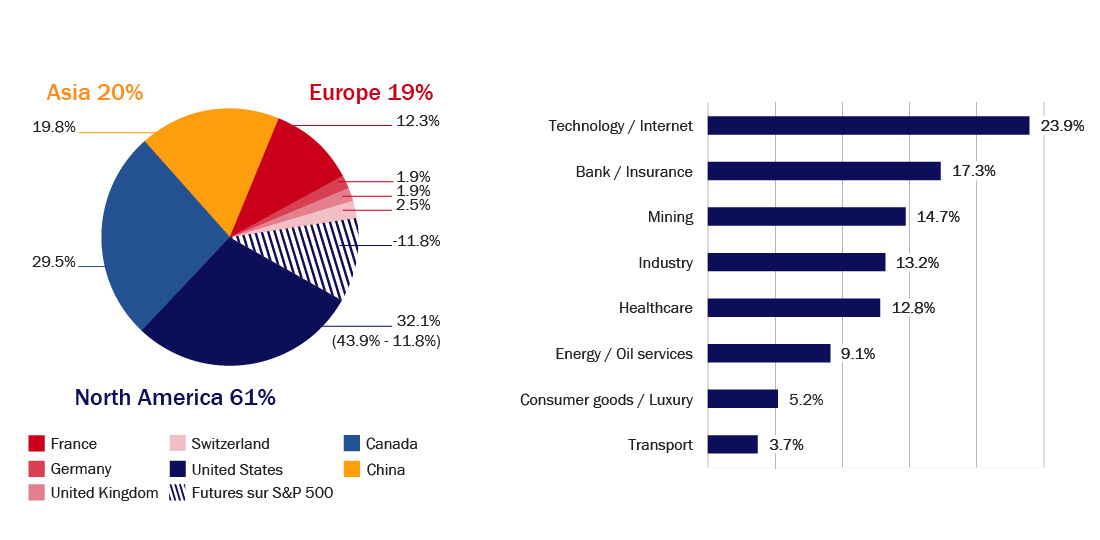
Source: Rothschild & Co Asset Management Europe, 30/09/2019
Within the fixed-income portfolio, geographical allocation remained relatively stable over the quarter. The proportion of money-market assets was significantly reduced due to its negative yield and reinvested in BBB and A-rated securities with intermediate maturities. Wider credit spreads and higher interest rates observed between late August and early September enabled us to make this shift. The allocation in the High Yield segment is highly selective and consists mainly of BB-rated bonds, which are less sensitive to the economic cycle, as well as a few B-rated securities backed by strong convictions.
R-co Valor Balanced: Geographical and by rating breakdown of the fixed income pocket as of September 2019
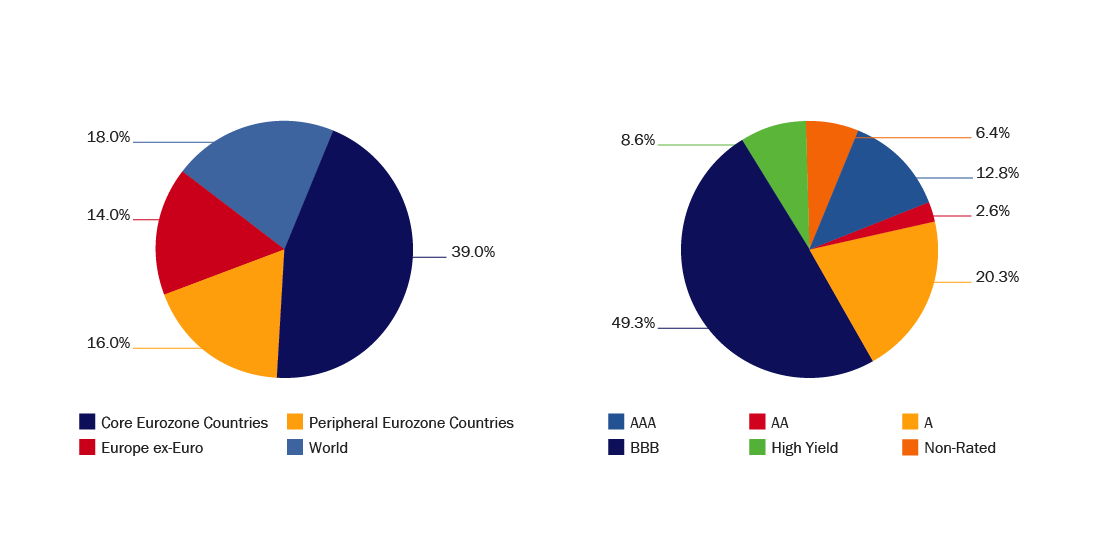 Source: Rothschild & Co Asset Management Europe, 30/09/2019
The features of the portfolio are not fixed and may vary over time.
Find all the information available on the fund : R-co Valor
Find all the information available on the fund : R-co Valor Balanced


