
Anthony Bailly
Head of European Equity

Head of European Equity

European Equities Portfolio Manager

Two issues alternatively drove the markets in 2021 inflation and the Covid-19 pandemic. Every time inflation returned to the forefront, pushing interest rates upward, Value stocks outperformed. This was the case during the first half of the year, when the market played the reflation trade until mid-May, and then in September, with the tapering announcement. However, each time there was a resurgence in the pandemic (the fourth wave during the summer, then a fifth wave in autumn), Growth style beat Value, and outperformed it as of the end of November.
These two issues cancelled each other out in December, as the emergence of Omicron reinforced pandemic concerns, while the Fed decision to set aside inflation “transitory” nature, marked an acceleration in the monetary tightening policy announced back in September. Ultimately, despite Value style renewed momentum in December, Growth style outperformed Value style by 3.4%(1) in 2021, as investors overweighted stocks offering clear visibility, fearing the impact that potential restrictions occurring early 2022 may have on economic growth
From a health perspective, even though Omicron continues to spread worldwide, the less dangerous nature of the variant and the high level of vaccination in Western economies, suggests that the situation is still under control and it may be possible to “live with the virus”. This is the view taken by the markets at the beginning of the year, as they have clearly chosen to focus on the signals sent by the central banks. They were particularly receptive to the one sent by the Federal Reserve, whose Minutes, published on 5 January, were explicit in mentioning the acceleration of tapering with earlier than expected balance sheet reduction.
It resulted in an accelerating trend of sovereign interest rates that began mid-December, whereas inflation expectations are slightly receding as some commodity prices pull back, apart from oil prices. Therefore, despite investors’ doubts, real rates have indeed risen early this year and could be the main theme for 2022. The close correlation between interest rates (especially real rates) and Value style is well documented, and this is the reason for the aggressive rotation seen so far this year.
1. The macroeconomic environment is still favourable: Eurozone economic growth consensus forecasts are around 4.3%(2), far higher than its potential growth (around 1-1.5%)(3). This growth is being driven by: 1) surplus household savings (about 6 percentage points of GDP in the eurozone); 2) companies’ stocks replenishment ; 3) the investments needed for upgrading manufacturing facilities; and 4) the roll-out of the European Commission’s stimulus plan.
2. EPS growth forecasts are too conservative for 2022: Despite this promising macroeconomic environment, the consensus forecast a 7% increase(4) in EuroStoxx EPS figures for 2022 – the lowest expectations in the past 30 years. This would mean a squeeze on margins, due to the steep rise in inputs (higher commodity prices and wages). We do not share this view, especially regarding cyclical and financial sectors, for the following reasons:
3. Valuations are still more attractive: The performance of Value sectors in 2021 did not reflect the steep rise in their earnings, which worsened even more the Value’s relative valuation in 2021. Possible additional upside revisions of 2022 forecasts make us especially confident in Value upside potential. The segment’s valuation is currently discounted at an all-time low (with P/Earnings remaining below 10x in most sectors).
As 2022 begins, we are holding onto: 1) our heavy overweightings of financials (Banks) and cyclicals (Automobile, Energy, Leisure-Travel and Construction); and 2) our underweighting of Growth sectors (Technology and Consumer Goods)(6), whose very high valuations look risky in an environment of rising real rates.
Despite some steep rallies, our main convictions (financials and cyclicals) continue to offer significant upside potential. We are sticking to these convictions, as we feel that the market is not currently pricing in either the recovery in margins in 2021, or the bright prospects for 2022. We are also exposed to the theme of reopenings (via our Leisure-Travel position), set up in the second half of 2021. It slightly penalised the fund last year but could be a significant contributor to performance in 2022, if the public health situation returns to normal. Meanwhile, the weighting of our defensive pillar remains low about 15-20% of the portfolio), based on our view that the cycle should remain promising this year.
We remain convinced of the strong rebound potential of Value, which could occur in the coming months, as the public health situation returns to normal, and as interest rates rise, which will be powerful drivers of performance in 2022. If the Covid-19 pandemic is put on the backburner, investors will once again focus on the solid fundamentals of Value stocks and on the current shift in monetary policy. Higher real interest rates are likely to lead to a favourable rotation into Value and could also have an unfavourable impact on Growth. Cyclical and financial stocks, whose valuations are still more attractive, could rally strongly.
The fund performed well in 2021, with a 26.3%(7) gain, hence a +3.6% outperformance vs. its benchmark index, EuroStoxx Total Return, with dividends reinvested. It therefore stood out within the Value universe.
This outperformance was mostly driven by good stock-picking, mainly in the energy (ENI), construction (Saint Gobain), commodities (Arcelor) and auto (Stellantis and Daimler)(8) sectors. The positive allocation impact from overweighting banking stocks also helped, but, here again, stock-picking added performance with Unicredit and Société Générale(8) being the best contributors to performance this year.
All in all, it was indeed our fundamentals-based approach that allowed the fund to outperform in 2021. Our scenario appears to have been borne out in the first days of 2022, with a very aggressive rotation into the Value style. R-co Conviction Equity Value Euro has taken full advantage, with a performance of 2.6% year-to-date as of 10 January 2022, thus outperforming its benchmark index (EuroStoxx Total Return, with reinvested dividends) by 4.1%.
Completed on 11 January 2022
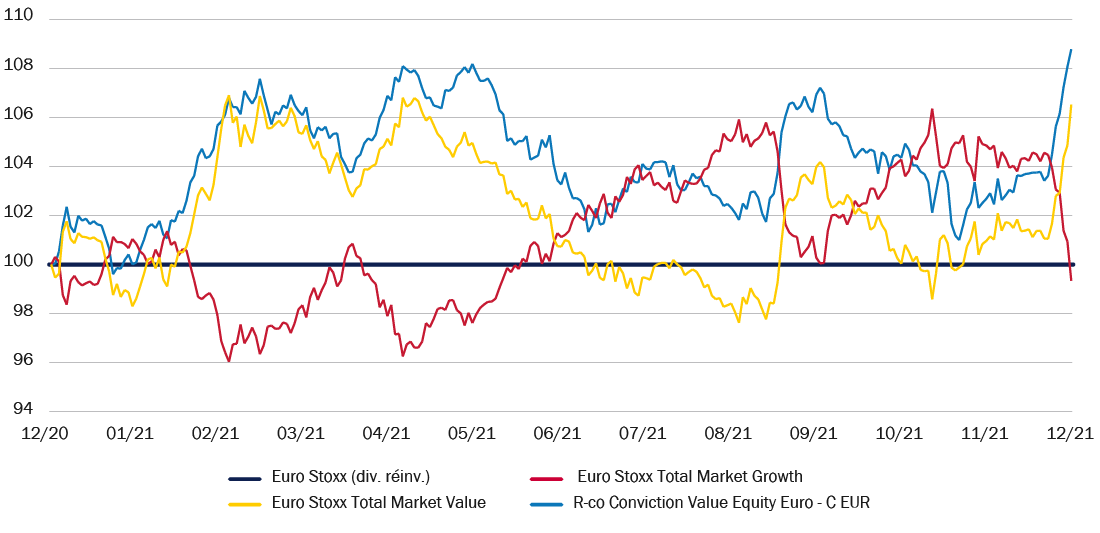
Benchmark index since 31 December 2012: Euro Stoxx with dividends reinvested Note: Base 100 as of 31/12/2020.
Source: Bloomberg, Rothschild & Co Asset Management Europe – 10/01/2022
(1) Source: Bloomberg - Value SLVT Index, Growth SLGT Index performance from 31 Dec. 2020 to 31 Dec. 2021.
(2) Source: OECD, January 2022.
(3) Source: Natixis, January 2022.
(4) Source: FactSet, December 2021.
(5) This is not to be construed as investment advice, tax advice, an investment recommendation or advice from Rothschild & Co Asset Management Europe.
(6) Allocations and geographical and sector breakdowns are not permanent and are subject to change over time within the limits set in the prospectus.
(7) As of 31 December 2021, C units (EUR).
(8) This is not to be construed as investment advice, tax advice, an investment recommendation or advice from Rothschild & Co Asset Management Europe.


