
Yoann Ignatiew
General Partner, Head of International Equity and Diversified

General Partner, Head of International Equity and Diversified

General Partner, Head of Fixed Income

Global Equities Portfolio Manager
The equity markets ended the year on an overall positive note – despite the news on the Omicron variant. The MSCI All Country World Index gained +16.80% this year, driven mainly by the US (with the S&P 500 up by +26.9% in dollars) and Europe (Euro Stoxx 50 up by +21% in euros). Emerging markets (MSCI Emerging down by -4.6%)(1), however, took a hit from heavy inflationary pressures and from government support measures that were more limited in many cases.
On the one hand, battle-weary investors quickly took in the news on Omicron. The new variant does indeed appear to be highly contagious, even amongst revaccinees. On the other hand: 1) most people who are infected have only mild symptoms; and 2) vaccines appear to offer protection from more serious forms of the disease. Many investors currently regard Omicron as less of a true public health threat and more as a potential driver of inflation, mainly through its worsening supply-chain disruptions.
Central banks, meanwhile, are changing their stances one after the other, with a gradual shift towards the path of normalisation. The Fed, for example, announced in December an acceleration in its tapering process(2); in a surprise move, the BoE(3) raised its key rate to 0.25%; and the ECB(4) flagged the end of its PEPP purchases, effective March 2022. Despite their nervousness prior to each central bank meeting, market participants appear to have resigned themselves to living with less abundant liquidity. They are nonetheless keeping a close eye on interest rate hikes, mainly in the US, where an earlier-than-expected – or even worse, a stronger-than-expected – hike could be one of the main market risks for 2022.
In China, a significant shift in the official mindset was evident after the Politburo meeting. The Chinese Communist Party served notice that it was concerned by the weakness of domestic demand. As a result, banks’ mandatory reserve ratio was lowered, thus freeing up 188 billion dollars in liquidity. In addition, the focus was on making growth more sustainable and on supporting domestic consumption, thus providing a relative lull on the regulatory risk front.
At the end of this busy quarter, R-co Valor had net equity exposure of 86%. During the fourth quarter, its top performance contributors were in the luxury goods and mining sector. The mining sector was driven by gold, which was boosted, in turn, mainly by Newcrest’s acquisition of Pretium, but also by its diversified mining component. As a result, the top five contributors included Ivanhoe Mines and Teck Resources, respectively copper and diversified raw material producers, which were driven ahead by high ore prices. China’s restrictions and its “zero-Covid” policy have hit the leisure services sector hard, and was the most underperformed contributor alongside the tech sector.
The fund added opportunistically to some of its positions, while reducing its most cyclical exposures. Profits were taken on some stocks, particularly in commodities (Canadian Natural Resources), manufacturing (Bombardier) and financials (Capital One). Exposure to the luxury sector was also reduced after its performance on the quarter. Some exposure was added marginally to tech stocks in particular (Alibaba and Uber), as well as to European industrials, with Alstom(5).
Inflation and central bank policies are at the top of the list of challenges we have identified for 2022. Beyond the mere normalisation of monetary policies, fears are crystallising around the pace of key rate hikes. While Jerome Powell appears to have mastered his tightrope act so far, a steeper-than-expected rate hike could have a significant impact on the cycle recovery.
However, some factors are at play that could support the equity markets in the coming months, led by macroeconomic releases that are once again surprisingly strong. Moreover, governments remain closely involved, and outlays from stimulus plans continue to be released in different parts of the world. On top of that, surplus US household savings and companies’ determination to rebuild their inventories are both strong drivers of the recovery. It will also be worth keeping an eye on 2021’s fourth quarter company results, as they could hold positive surprises and provide solid support to the markets.
Completed on 7 January 2022
(1) Performances stated in local currencies.
(2) Tapering is the gradual reduction in central banks’ monetary easing policies.
(3) Bank of England.
(4) European Central Bank
(5) This is not to be construed as investment or tax advice, or as an investment recommendation or advice from Rothschild & Co Asset Management Europe.
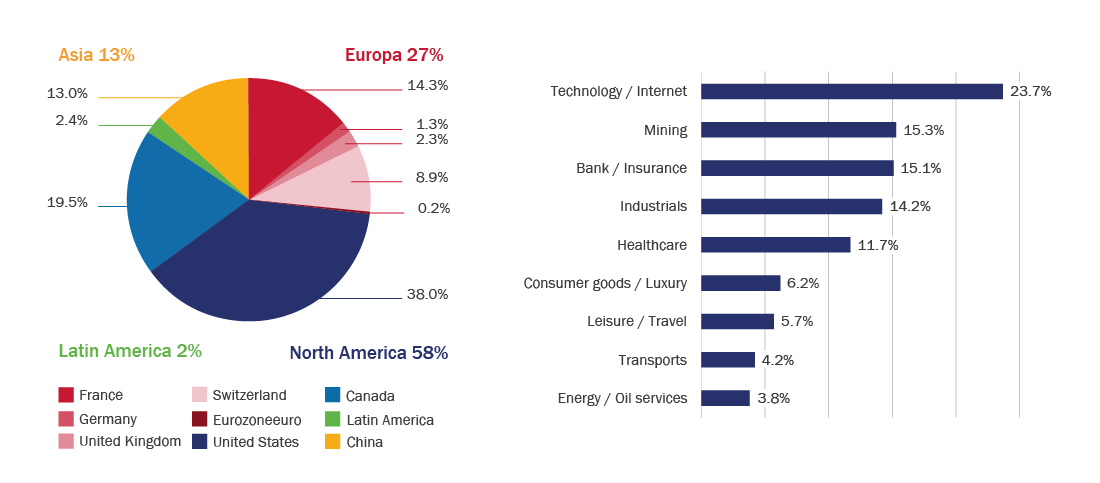
Source : Rothschild & Co Asset Management Europe, 31/12/2021
The fund’s equity exposure was unchanged during the fourth quarter, at 43%. Its bond allocation came to 48% at the end of December.

Source: Rothschild & Co Asset Management Europe, 31/12/2021.
The equity allocation of R-co Valor Balanced replicates the allocation of R-co Valor. Changes made to the two funds and their positions were identical.
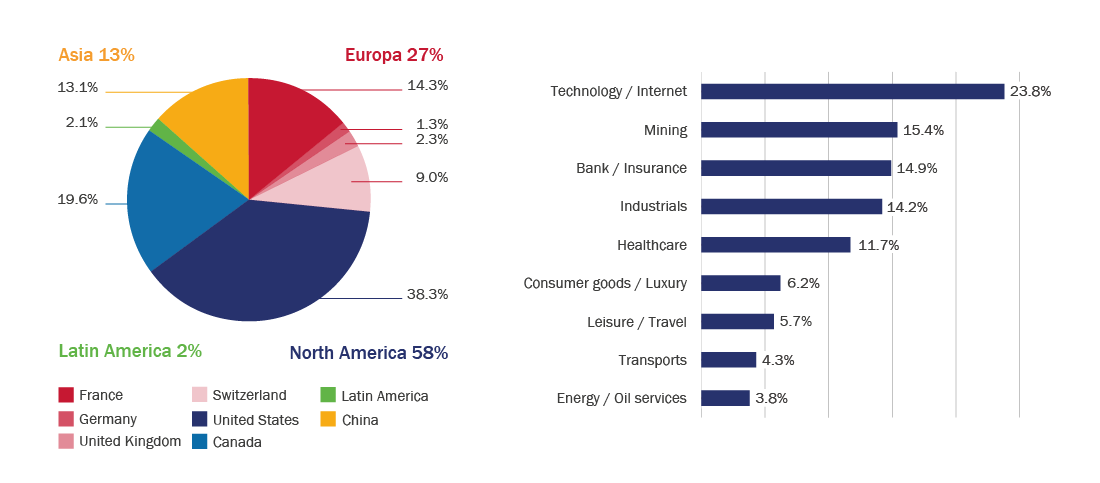
Source: Rothschild & Co Asset Management Europe, 31/12/2021.
The allocations and breakdowns, both geographical and sectoral, are not fixed and are subject to change over time, within the limits of the prospectus.
The fourth quarter featured steep volatility in government bond yields, driven by both inflationary fears and the worsening in the pandemic situation. These concerns, paired with demanding valuations, triggered a widening in credit spreads(1). This change in paradigm led investors towards a more risk-off stance in recent months. As a result, issue premiums re-emerged in recent weeks after spending most of the year at close to 0. On the euro primary market, high yield(2) set a new record with almost 135 billion euros in issuance. The investment grade market(3) was not as busy in 2021 as in 2020 but nonetheless accounted for 300 billion euros in issuance(4).
We lowered the fund’s bond exposure slightly, to 48% in December. We sold off some short-term, low-yielding bonds during the quarter, as well as some riskier paper. The proceeds gave us the leeway to seize investment opportunities early in the year, which historically is an attractive period for issuance. Meanwhile, we recently acquired bonds that are exposed to the economic reopening, including EasyJet, an airline with solid finances and low debt. 2022 has started off in an uncertain environment, with central banks talking about raising interest rates. Credit market fundamentals remain solid with extremely low default rates, in both Europe and the US. Even so, it will be worth keeping an eye on rising US government bond yields, as an exaggerated shift would be likely to undermine investor optimism.
Completed on 7 January 2022
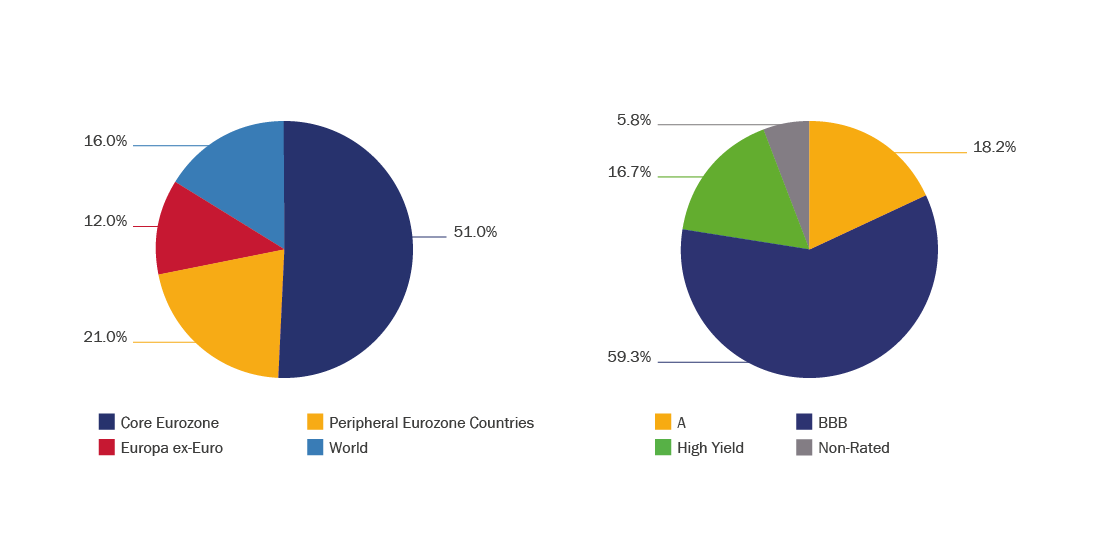
Source: Rothschild & Co Asset Management Europe, 31/12/2021.
(1) A spread is the difference between yields of one bond and another “risk-free” bond of equivalent maturity.
(2) High yield bonds are issued by companies or governments having high credit risk. They are rated lower than BBB- by Standard & Poor’s.
(3) A debt security issued by companies or governments rated by Standard & Poor’s between AAA and BBB-.
(4) Source: Société Générale, CIB – 2022.


