
Yoann Ignatiew
General Partner, Head of International Equity and Diversified

General Partner, Head of International Equity and Diversified

Global Equities Portfolio Manager

General Partner, Head of Fixed Income
The exceptional support measures implemented by governments and central banks put in place since March have enabled the third quarter to show signs of recovery. The euphoric summer months were tempered by a sluggish month of September. The upcoming US presidential elections, coupled with the threat of a second wave of contamination, have weighed heavily on the markets. Solid macroeconomic figures and the prospect of a vaccine in the short term, both of which were driving forces in the first part of the quarter, were not sufficient to offset the political and pandemic-related uncertainties of the back-to-school period.
The world’s economies are getting going again at varying speeds, with China leading the way. In addition to having virtually no new cases of Covid-19 since mid-August, it is the only major economy that is in a position to forecast positive growth over the year (+1.9% according to the IMF). The only cloud in the sky, however, comes from household consumption. Although it is picking up slightly, it remains anaemic. In the US, despite the rather encouraging macroeconomic figures (unemployment down sharply, at 7.9%, PMI composite index[1] at 55.4) and an extremely accommodating Federal Reserve, political risks are weighing on investor sentiment. The US elections are currently taking centre stage in the debates. Besides the issue of who is going to be in the White House for the next four years, the majority that the Republicans currently enjoy in the Senate is also up for grabs. A “Blue wave[2]” would allow Joe Biden to raise taxes as per his manifesto, but also to pass a substantial plan to support the US economy. In Europe, fears around the risk of a second wave of coronavirus crystallised, driving some countries to put parts of their territory back under lockdown.
The macroeconomic figures are a mixed bag, with weaker growth in the PMIs on the one hand (50.4 in September as against 51.9 in August) but, on the other, the investor sentiment index (ZEW) reaching its highest point in September since the start of the millennium.
[1] The Purchasing Managers’ Index, an indicator that measures the level of trust purchasing managers have in a given sector. Above 50, it shows that the sector is expanding, and below 50, the sector is contracting. The composite index includes the industrial and services sectors. [2] A scenario that would see the Democrats taking the White House and the Senate.
Within the R-co Valor portfolio, exposure to equities has marginally increased since the end of June, from 82% to 83% at the end of September. Tactical reinforcements were made, primarily on cyclical[1] and healthcare stocks. The latter, under pressure, have under-performed in recent weeks with the US elections around the corner. Purchasing opportunities presented themselves with regard to stocks like Biomarin or AstraZeneca. Our positions on cyclical stocks such as The Walt Disney Company were also strengthened. The Group is gradually making its mark as a mover and shaker in the on-demand video sector, and now has over 100 million customers on its streaming platforms worldwide. At the same time, within the portfolio, a profit-taking strategy was implemented throughout the rally of the indices during the summer months. Technology stocks like Alphabet and Tencent were trimmed following the Nasdaq’s spectacular performance, at 31% over the year at the end of August. Mining stocks (Ivanhoe Mines and Agnico Eagle Mines) were trimmed, in order to limit their weight in the fund after they increased sharply.
Volatility will remain high in the markets in the run-up to the US elections. The risk that Donald Trump might challenge the results, under cover of potential fraud linked to postal votes, must not be overlooked. This is particularly relevant given that Trump refused to commit to a transfer of power in the event that he is declared defeated after the elections. The level of the VIX index[2] nevertheless appears to indicate that investors have already - at least partly - integrated this possibility. In the event of a “Blue Wave”, we think that the likelihood of Joe Biden immediately implementing a significant tax increase is limited, as the risk of slowing the country’s economic recovery is too great. Moreover, a vaccine against Covid-19, expected to arrive in early 2021, would serve to support the markets, and more specifically cyclical stocks, which were the main focus of the investments made in R-co Valor throughout the second quarter.
[1] Cyclical stocks are highly correlated to economic cycles. They therefore benefit strongly from periods of recovery and expansion but are also the first to be affected by an economic downturn. [2] Indicator of the volatility in the US financial market.

Source: Rothschild & Co Asset Management Europe, 30/09/2020.
The features of the portfolio are not fixed and may vary over time.

Source: Rothschild & Co Asset Management Europe, 30/09/2020.
The features of the portfolio are not fixed and may vary over time.
Portfolio Allocation
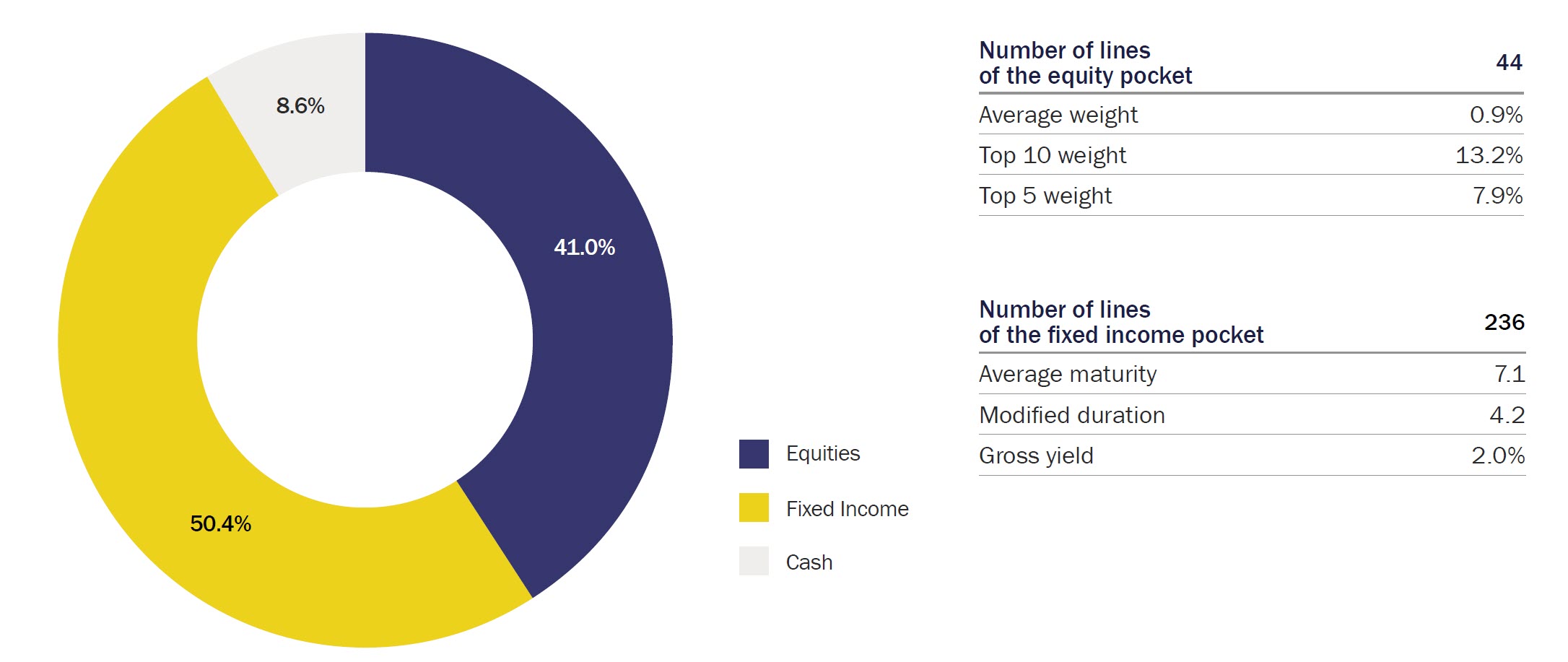
During the third quarter, equity exposure marginally increased, reaching 41%. The fixed income component remained stable quarter-on-quarter, at around 50%.
Source: Rothschild & Co Asset Management Europe, 30/09/2020.
The features of the portfolio are not fixed and may vary over time.
As a reminder, the equity component of R-co Valor Balanced replicates the allocation of R-co Valor. The trades made and the positioning are identical and indicated in the first part of this document.
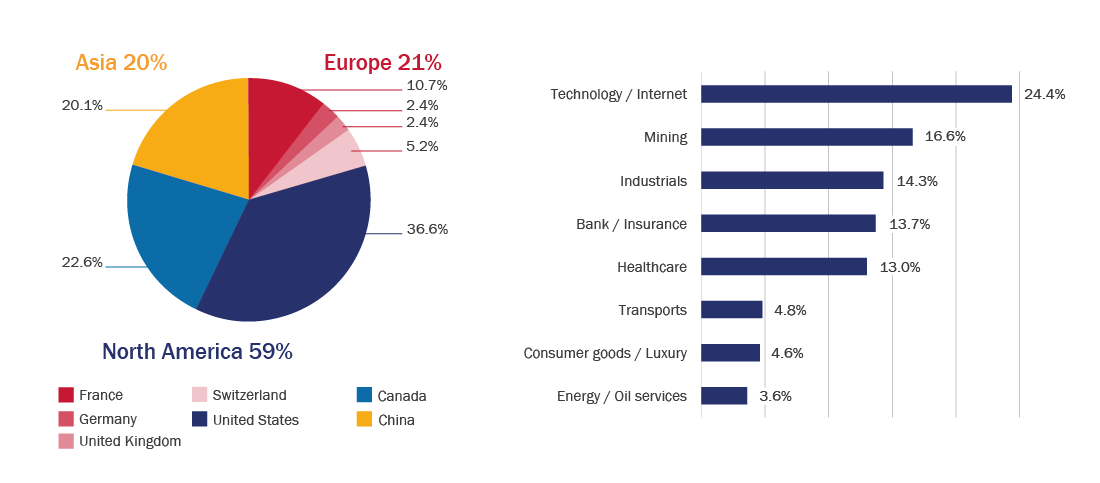
At the end of this quarter, the technology and Internet sectors are continuing to dominate the allocation of the equity component. The mining sector is gaining two places and moving up to second place, whereas industrials are moving down a notch and completing the leading trio. The healthcare sector, formerly in third place, is now relegated to fifth place.
Geographically, exposure remains relatively stable, with very light reweighting of North America in favour of Europe. No major change was made, however.
Source: Rothschild & Co Asset Management Europe, 30/09/2020.
The features of the portfolio are not fixed and may vary over time.
As for equity markets, the fixed income markets saw things moving at two different paces during the third quarter. After a strong summer (Investment Grade[1] bonds in euros recorded a 2% performance over this period and High Yield[2] bonds, 2.6%), September proved to be a more modest month. In Europe, the rise in Covid-19 cases, the announcement of new restrictions and the uncertainty about the economic recovery heavily weighed on the credit market. Regarding issuances, since the start of the year, the figures remained significant: EUR 346 billion for non-financial related Investment Grade bonds, i.e. a rise of 25% year-on-year.
At the same time, the still very accommodating policy of the ECB and the low interest rate environment are benefiting peripheral countries, not least Italy. Indeed, the stability of the government after the regional elections led to a 29-basis point decrease in the Italian 10-year rate, to 0.87%.
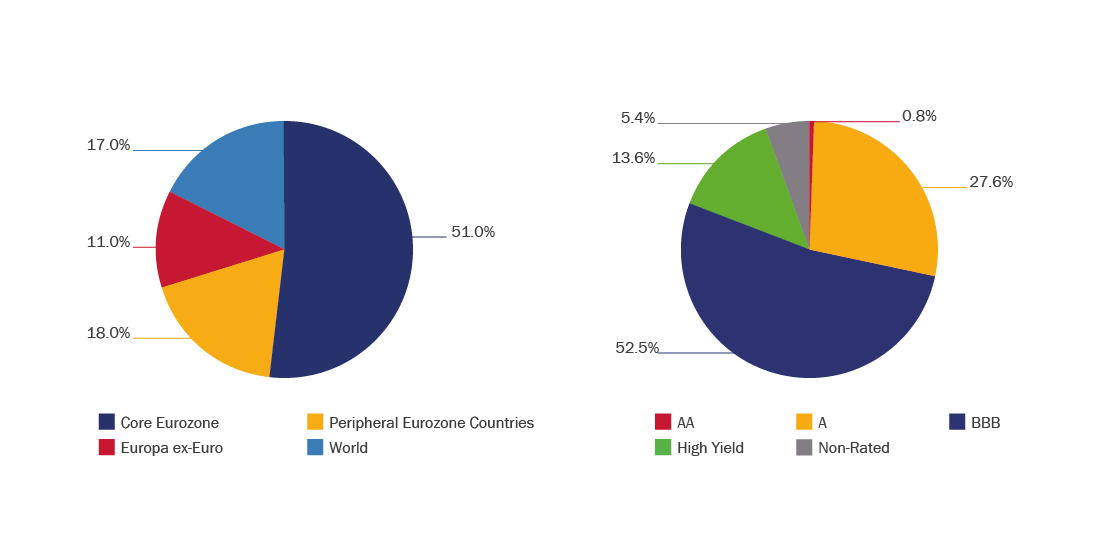
In the fixed income component, the risk was reduced throughout the third quarter. The exposure to non-rated and high yield bonds was decreased, from 23% at the end of June to 19% at the end of September. Thus, certain lines with low contributions were sold and positions with substantial weight were trimmed. The return of volatility in September made it possible to benefit from issuance premiums again. Taking advantage of this shift, investments were mainly made in the primary market, in Investment Grade bonds in euros with a resilient profile. As a result, the bond exposure was brought to 50% of the fund.
Source: Rothschild & Co Asset Management Europe, 30/09/2020.
The features of the portfolio are not fixed and may vary over time.
[1] Debt security issued by companies or States with a rating between AAA and BBB- on the Standard & Poor scale. [2] High yield bonds are issued by companies or States with a high credit risk. Their credit rating is below BBB- on the Standard & Poor scale.


