
Yoann Ignatiew
General Partner, Head of International Equity and Diversified


General Partner, Head of International Equity and Diversified

Global Equities Portfolio Manager

General Partner, Head of Fixed Income
The last quarter of the year was influenced by a succession of market-friendly announcements: the end of electoral uncertainty in the United States, the development of effective vaccines against Covid-19, the conclusion of the “Brexit” saga, etc. In the process, some equity indices have reached record highs, such as the S&P 500, which returned nearly 12% in the quarter [1].
The macroeconomic picture remains mixed. The recovery that began in the third quarter was prematurely slowed down by the resurgence of infections, leading to additional restrictive measures in Europe and the United States. Symptoms of this dichotomy can be identified in the Manufacturing PMI [2] in Europe which expanded to 55, while the PMI for the service sector PMI fell significantly to 46.
In the United States, the declining unemployment rate, currently at 6.7% [3], actually hides large disparities within the population. It also excludes from the statistics any individual no longer actively seeking employment. For its part, China seems to be emerging from this pandemic standing tall, showing GDP growth of 6.5% in the fourth quarter and a trade balance reaching a record global surplus of 535 billion dollars [4].
Markets seem to be moving along, supported by rather buoyant macroeconomic figures, particularly accommodating central banks, and significant stimulus plans. Three situations could however become headwinds:
The horizon has nevertheless brightened up at the end of the year, fuelling hopes for a return to normality in 2021. With the pandemic under control and pent-up demand built over a year, the economic recovery could prove solid in the coming months.
[1] Source: Bloomberg, 21/12/2021.
[2] The Purchasing Managers’ Index is an indicator that measures the level of trust purchasing managers have in a given sector. If it is above 50, it shows that the sector is expanding, and below 50, that the sector is contracting. .
[3] Source: Bureau of Labor Statistics, December 2020.
[4] Brèves hebdomadaires du SER de Pékin, 01/02/2021.
Driven by a procyclical reallocation of equity markets, R-co Valor benefited from the performance of its industrial, financial and commodity allocations in the fourth quarter. Exposure to equities increased marginally since the end of September, from 83% to 84% at the end of December.
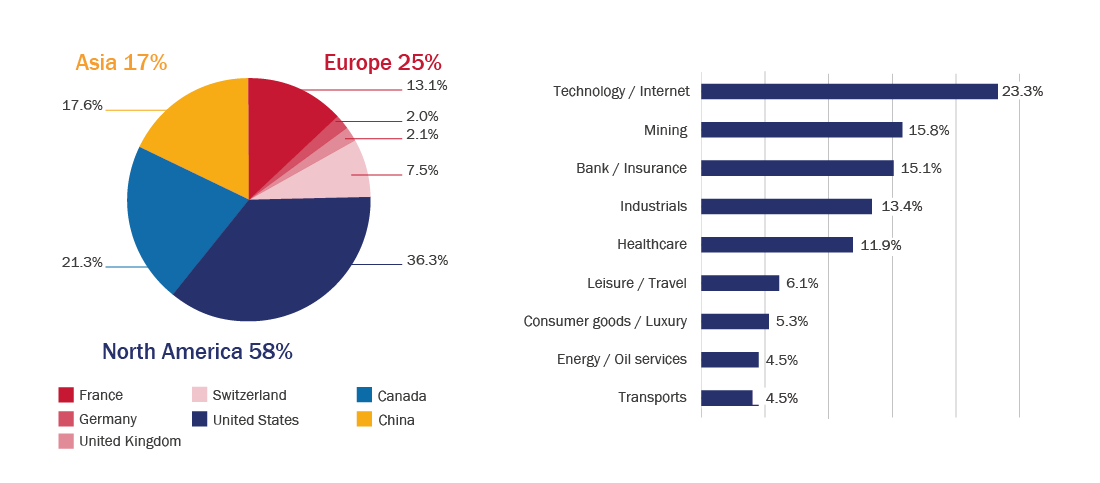
Profits were taken strategically as equity markets recovered. Some cyclical stocks were trimmed and the allocation to the automotive sector was completely sold with the exits of equipment manufacturer Magna International and Chinese manufacturer Great Wall Motor. In parallel, stocks with a more defensive profile, in particular those in the health and gold mining sectors, were reinforced. We also added some stocks in the tech sector at the margin following a correction at the end of the year, providing attractive entry points. French rail group Alstom was initiated over the period within industrials, which is a key player in sustainable mobility. Geographic exposure shifted slightly in favour of Europe, reaching a 25% weight within the equity portfolio at the end of December. North America and China represented 58% and 17%, respectively.

Source: Rothschild & Co Asset Management Europe, 31/12/2020.
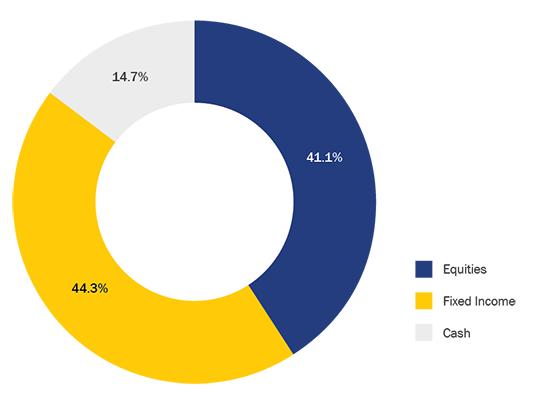
During the fourth quarter, equity exposure increased marginally to 41%. The fixed income pocket was significantly reduced, from 50% to 44%, between the end of September and the end of December.
Source: Rothschild & Co Asset Management Europe, 31/12/2020.
The equity pocket of R-co Valor Balanced replicates that of R-co Valor. The movements executed, as well as the positioning, are thus identical. Technology is the largest sector allocation, similarly to last quarter. The mining allocation comes second, while financials moved up to third place.
Source: Rothschild & Co Asset Management Europe, 31/12/2020.
The “Brexit” agreement, the ECB announcements, and the hopes for another US stimulus package have all supported the market as investors continued to increase their exposure to the riskier segment of the asset class. The primary market was particularly dynamic in Europe during the year, with EUR 382 billion [5] issued in Investment Grade [6]. Volumes should naturally decline over the next few months following a record year in 2020. Issuers currently benefit from extremely favourable financing conditions. The yield on Investment Grade came close to 0%, while High Yield [7] almost came back to its level at the start of the year. In this context, it had become essential to create some room for manoeuvre by reducing exposure. Withing the fixed income pocket, we not only sold positions that were very dependent on the economic cycle or linked to changes in the health situation, which performed particularly well during the last weeks of the year (Carnival 2029, Novafives 2025, Sarens 2027...), but also low-yield short-maturity securities, or even certain High Yield positions. On the other hand, we invested in securities with a resilient profile mainly within the primary market. This repositioning should provide us with the flexibility to act quickly if a paradigm shift occurs In addition, a hedge has been implemented to partially cover the High Yield exposure.
[5] Source: Morgan Stanley, December 2020.
[6] Debt security issued by companies or States with a rating between AAA and BBB- on the Standard & Poor scale.
[7] High yield bonds are issued by companies or States with a high credit risk. Their credit rating is below BBB- on the Standard & Poor scale.

Source : Rothschild & Co Asset Management Europe, 31/12/2020.
The features of the portfolio are not fixed and may vary over time within the limits provided in the fund prospectus.


