

Thus, the Euro Stoxx 50 posted a slight decline of -0.40% in euros over the third quarter, while the S&P 500 and the Nasdaq ended the year at +0.23% and -0.38% respectively, both in dollars. Over the period, China corrected sharply (-14.75% for the Hang Seng index in Hong Kong dollars), impacted by a succession of anxiety-ridden events for investors: the hardening tone of the Chinese Communist Party, Evergrande’s collapse, energy price surge…
R-co Valor
In this context, central banks are continuing their balancing act as they begin the process of monetary policy normalisation. While the United States are ahead of Europe, the Fed seems to be positioning itself for the start of tapering(1) by the end of the year, with an announcement expected in November. The topic of rate hikes, which is fundamentally a source of anxiety for financial markets, seems for the time being to be decoupled from this first stage. Nevertheless, Fed members are now forecasting a hike sooner than a few months ago, with a rise expected by the end of 2022(2). In Europe, Christine Lagarde confirmed the ECB’s support by reiterating her position on the “temporary” nature of inflation due to structural factors related to supply chainsissues and rising energy prices.
Europe seems to be standing out for the sturdiness of its recovery. Business confidence in the Eurozone was thus notable for its resilience in September, as the OECD revised its growth forecast for 2022 upwards to 4.6%(3). However, in Germany, following the elections, long negotiations are expected to lead to a stable coalition. The FDP coming to power could make budgetary discussions more complex at the European level.
On the other side of the Atlantic, political tensions are tempering the optimism of market participants. Although an agreement avoiding a shutdown seems to have been reached, raising the debt ceiling, scheduled for October 18th, remains the next deadline. At the same time, the battle continues in Congress over the various investment plans proposed by the US government. Disagreements remain, both between Democrats and Republicans, but also within the Majority Party itself.
In China, the situation is becoming more complex. Fears surrounding the possible collapse of Evergrande, a sprawling group known for its real estate business, have been compounded by nationwide power cuts. The Coal price surge, which currently accounts for 60% of the country’s electricity production, coupled with President Xi Jinping’s ambition to achieve carbon neutrality goal of carbon neutrality by 2060, indiscriminately impacting individuals and companies, thus partially crippling the country’s manufacturing activity.
By the end of this eventful quarter, R-co Valor had a net equity exposure of 86% at the end of September. During the third quarter, the best contributors to performance were the industrial and energy sectors. The latter benefited from the surge in oil prices, supported by an OPEC+(4) that is not willing to significantly increase its production quotas for the time being. The significant rise in US interest rates has impacted the technology sector, which is the worst contributor to performance alongside leisure/services sector. Chinese stocks within these two themes heavily weighed on performance over the period.
In terms of portfolio movements, the growth and defensive parts were strengthened while the more cyclical part was trimmed. Profit taking was carried out on some stocks, notably from the commodity sector (Ivanhoe Mines), industrials (Bombardier) and financials (Morgan Stanley)(5). Positions were strengthened on stocks with a more defensive profile, particularly in the healthcare sector (Biomarin), but also on specific technology companies currently suffering from sector rotation but which still have outstanding growth prospects (Facebook following a reduction in Google,Vipshop).
What can we expect over the next few months? Concerns include emerging markets outlook, as some of them have limited flexibility to support their economies. Inflation has already forced several central banks to raise their key rates to stabilise expectations. This is the case for Brazil, Russia and Mexico. Furthermore, co-dependency between many of these countries and China can play against them. In the US, the political situation, fears over inflation and the Fed’s tightening monetary policy are weighing on investor
sentiment. Despite these factors, we remain confident and are keeping our equity exposure relatively stable at 86%. Our exposure to Europe, which is at a 10-year high, seems appropriate due to strong growth expectations over the next few years, particularly low company valuations and a momentum of buoyant flows. In the US, Jerome Powell seems to have the normalisation calendar under control for the time being and should gently lead the country towards monetary tightening. As for the investment plans, although they will probably not be voted on as they stand, they should prove to be solid supports for the economy, even if the amounts are revised downwards.
In China, although the situation does not seem to have stabilised yet, the sharp market correction has enabled us to strengthen certain lines at extremely attractive prices. The repositioning of the Party guideline, although causing high short-term volatility, does not, in our opinion, call into question the structural trend and the country’s positioning as an essential driver of the global economy.
[1] Tapering refers to the gradual reduction of monetary easing by central banks.
[2] Source: Fed “dot plots’’, September 2021. Dots plots are graphs with points that represent estimates of the evolution of interest rates.
[3] Source: Organisation for Economic Co-operation and Development (OECD), September 2021.
[4] Organisation of Petroleum Exporting Countries plus its partner countries.
[5] The comments and analyses in this document are provided purely for information purposes and do not constitute any investment recommendation or advice.
R-co Valor: Portfolio’s geographical and thematic breakdown
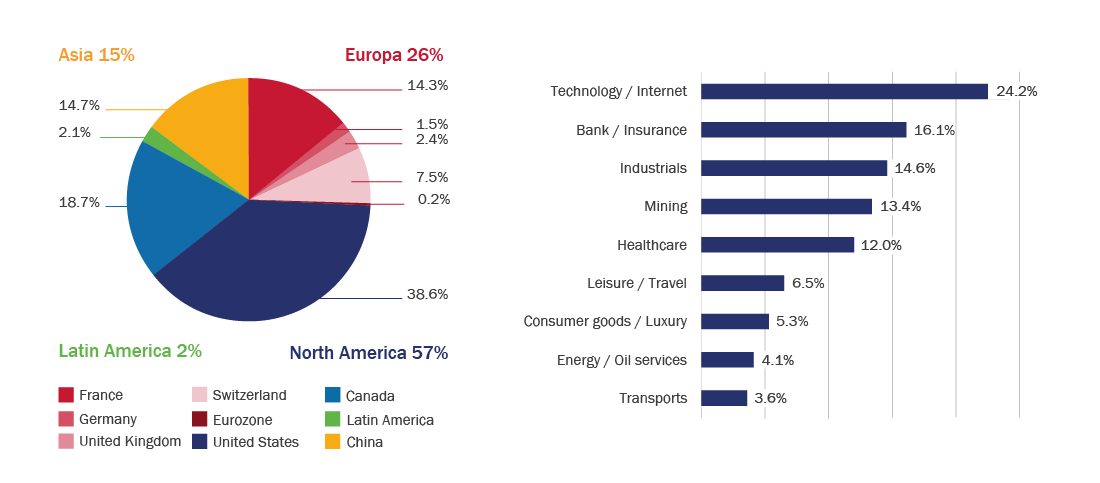
Source : Rothschild & Co Asset Management Europe, 30/09/2021.
The features of the portfolio are not fixed and may vary over time within the limits provided in the fund prospectus. The management team is subject to change. Figures provided relate to previous years. Past performance is not a reliable indicator of future performance and is not constant over time.


