
Yoann Ignatiew
General Partner, Head of International Equity and Diversified

General Partner, Head of International Equity and Diversified

Global Equities Portfolio Manager

General Partner, Head of Fixed Income
Although unemployment figures remain remarkably low in the United States, consumer confidence has fallen drastically(2). The real estate market has also tightened, and the rise in the average 30-year mortgage rate to around 6%(3) is adding further pressure on households with variable rate mortgages. Finally, the Fed's determination to fight inflation at all costs raises fears of a policy of rapid rate hikes, to the detriment of growth and employment.
In Europe, consumer confidence is also down. In addition to inflationary pressures, fears of a possible cut in gas supplies from Russia are clouding the outlook. The ECB, despite a policy that has so far been more permissive than its American counterpart, has also changed its tune, and several rate hikes are expected by the end of the year. Christine Lagarde has nonetheless declared her willingness to fight against financial fragmentation in response to the dramatic widening of spreads(4) on peripheral Eurozone government bonds.
Following a start to the year marked by the Covid-19, China shows a positive equity market in the second quarter(5). The area seems to be gradually coming out of lockdown and reopening its territory, lowering the quarantine period on arrival from 21 days to 7 days. The country, insulated from inflation for the moment, gives the Chinese central bank valuable leeway to support its economy. The Chinese Communist Party also seems particularly committed to achieving its 5.5% growth target, with the latest rumours indicating that the Chinese Ministry of Finance is considering allowing local governments to sell up to RMB 1,500 billion ($220 billion) of special bonds in the second half of the year to accelerate infrastructure financing(6).
R-co Valor posts a year-to-date performance of -10.4%(7). While the relative resilience of the fund over the first three months of the year was largely due to the positive contribution of the commodity sector in the portfolio, mining stocks were the worst contributors in the second quarter, despite our significant profit-taking in recent months. Fears of a global recession have hit commodity prices, which supply tensions have so far protected. Conversely, in line with the first three months of the year, the healthcare sector positively contributed to the fund's performance during the quarter. Our Chinese stocks, buoyed by the recovery in the region, also performed well over the period.
The fund's equity exposure increased marginally over the second quarter, from 82% at the end of March to 83.4% at the end of June. This risk increase took place in two ways. Firstly, we reallocated 2% of cash across the portfolio and, in parallel, we made opportunistic purchases, mainly on Growth stocks, with particularly attractive valuations on some companies. Reinforcements were made in the technology, travel & leisure, and industrial sectors. A new position was also initiated in the US banking sector. We continued our profit-taking strategy, exiting certain energy-related stocks and significantly reducing our exposure to diversified miners.
The "hawkish" stance of central bankers to fight rising prices weighed on the confidence of market participants during the second quarter. Nevertheless, following the deterioration of the economic situation, an easing in the pace of rate increases could be expected by the end of the year. On inflation, we believe we are not far from the peak if it is not already behind us. But more than the absolute level, the pace of decline is to be monitored, as it will determine the intensity of the response of central bankers. Companies' margins for the upcoming earnings season and their guidance(8) will set the tone for the coming weeks. The population's propensity to consume, particularly in the United States, should also support growth, despite a rather sluggish environment. While a deep recession by the end of the year is not our central scenario, we suffer, as does the market, from excessive and sometimes generalised movements in a sector, regardless of the quality of the companies. Nevertheless, we remain convinced that stock picking(9) remains crucial, as in the case of Seagen, a US biotech that has performed well in recent weeks following rumours of a purchase by Merck.

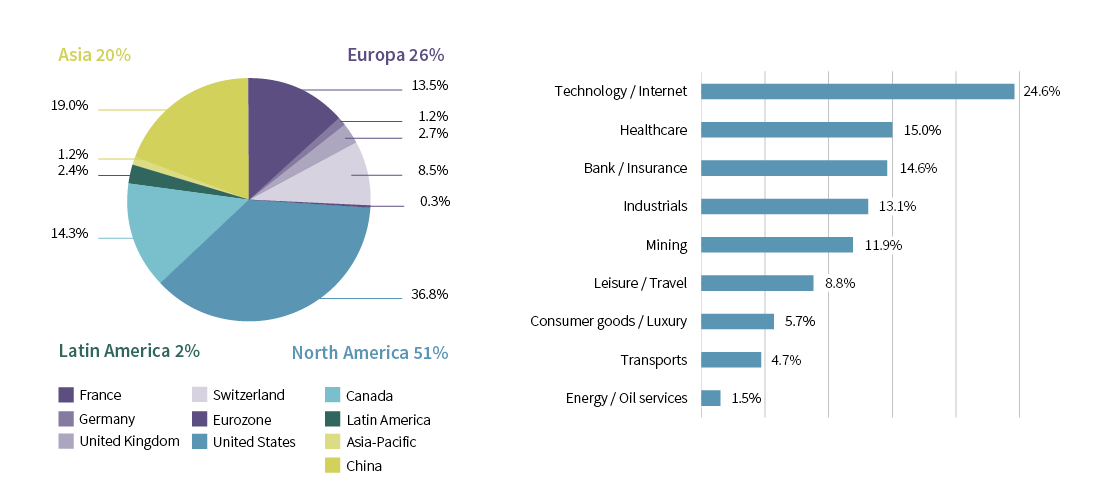

At the end of June, the fund's equity exposure stood at 43%. The bond portfolio was increased to 50%.

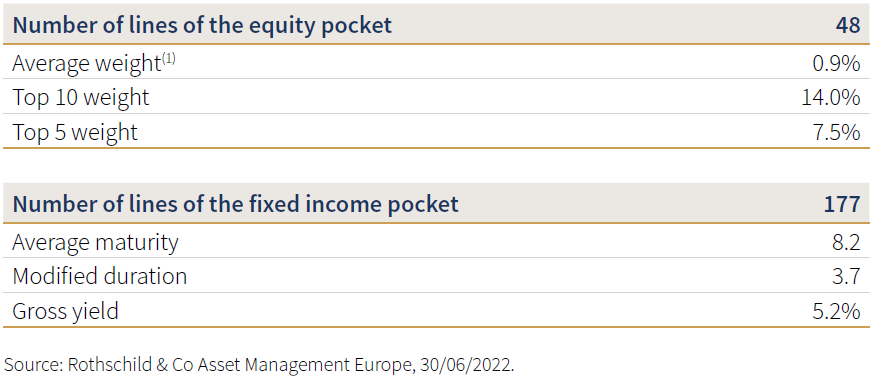
The equity portfolio of R-co Valor Balanced replicates that of R-co Valor. The movements executed, as well as the positioning, are identical.
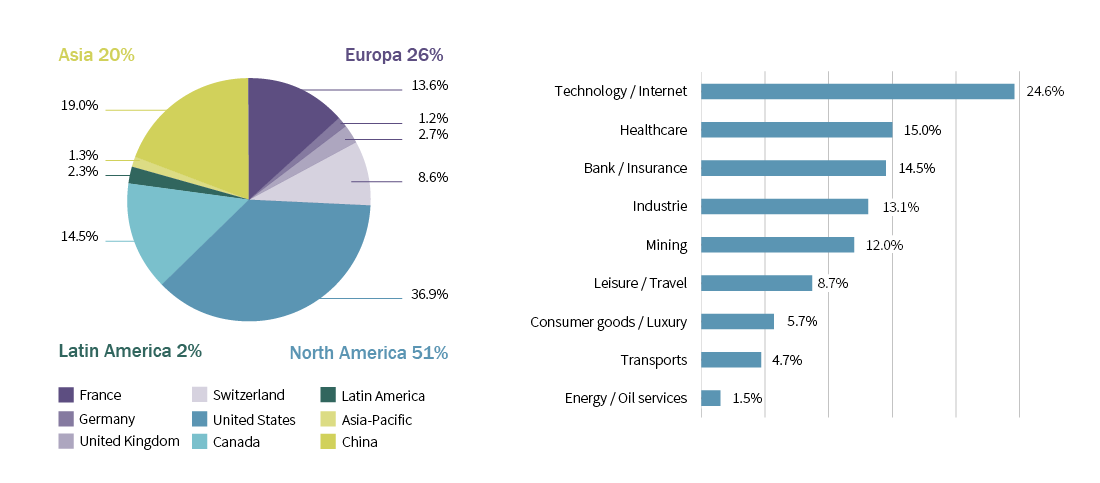
The upward movement in interest rates, which began at the beginning of the year, continued on both sides of the Atlantic. The German 10-year rate thus ended up 79 basis points (bps) over the quarter, at 1.33%(10). The US 10-year yield also rose significantly by 67 bps to 3.08%(10). Central banks in both zones have tightened their rhetoric in response to accelerating inflation, which has exceeded 8%(11). In the United States, the Fed raised its key interest rates by 75 bps in June, the largest increase since 1994. In Europe, the ECB enacted a 25 bp increase for the month of July, a move not seen for over 10 years(10).
Credit has suffered in Europe since the beginning of the year, impacted by both the rise in interest rates and the widening of spreads, Investment Grade(12) has fallen by -7.5%, and High Yield(13) has corrected by -10.6% over the quarter. June saw a sharp acceleration in the widening of credit spreads, with the Investment Grade segment under pressure by more than 50 basis points10. While High Yield has been resilient until now, it seems to have integrated a stronger risk of recession and is seeing its risk premiums tighten by 200 basis points. In terms of dynamics, there are still significant outflows in the asset class, and primary volumes are poor or non-existent for the riskiest debt segments.
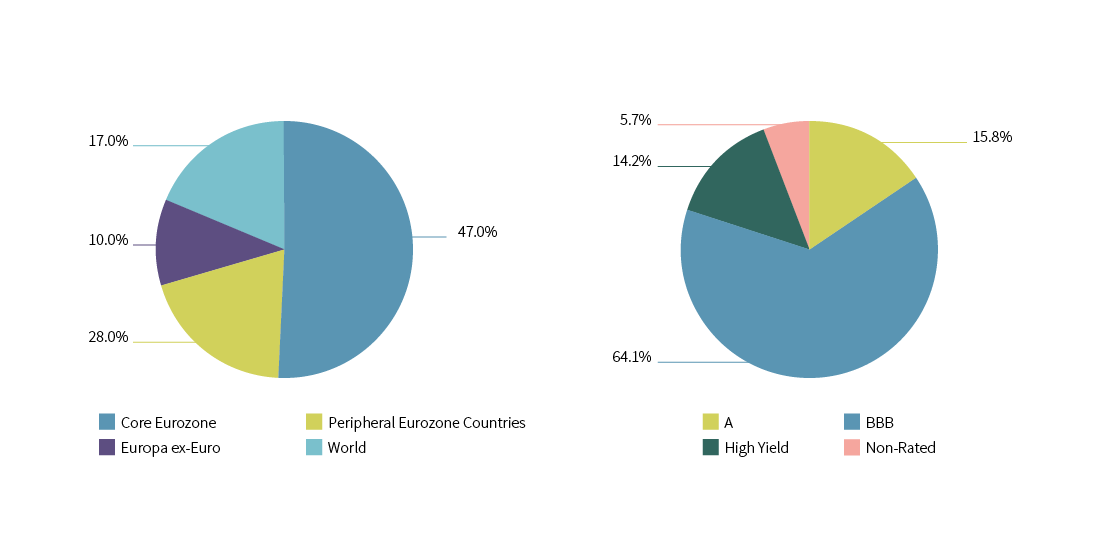
The portfolio suffered during the quarter, as did the euro credit market, impacted by the repricing(14) from central bank investors who were even less accommodating than expected. We reduced the risk in the fixed income portfolio, lowering the High Yield exposure from 19% to 14% over the quarter. On the buy side, we have mainly positioned ourselves in Investment Grade issues offering increasingly attractive yields. We continue to favour investments in the Investment Grade universe, offering good visibility in this difficult environment.
Completed on 11 July 2022
(1) Source: Bloomberg, 30/06/2022.
(2) Source: University of Michigan Consumer Sentiment Index – June 2022.
(3) Source: Bloomberg - July 2022.
(4) The spread refers to the difference in yield between a bond and a loan considered as “risk free”, of equivalent maturity.
(5) Source: Shanghai Shenzhen in local currency – June 2022.
(6) Source: Chinese Communist Party - June 2022.
(7) Source: Rothschild & Co Asset Management Europe, 30/06/2022.
(8) A company’s public estimates of its current and future earnings prospects.
(9) Stock selection.
(10) Source: Source: Bloomberg - June 2022.
(11) Source: Bloomberg, U.S. Bureau of Labor Statistics - June 2022.
(12)Debt securities issued by companies or governments rated between AAA and BBB- on the Standard & Poor’s scale.
(13)High-yield bonds are issued by companies or governments with a high credit risk. Their financial rating is below BBB- on the Standard & Poor’s scale.
(14) The change in the price of bonds when they are available for sale.
The figures quoted relate to the past months. Past performance is not a reliable indicator of future performance and is not constant over time. The management team is subject to change.
The allocations and breakdowns, both geographical and sectoral, are not fixed and are subject to change over time, within the limits of the prospectus.


