Yoann Ignatiew
General Partner, Head of International Equity and Diversified

General Partner, Head of International Equity and Diversified

Global Equities Portfolio Manager

General Partner, Head of Fixed Income
The first quarter of the year was punctuated by a succession of events that put financial markets to the test. From the Russian-Ukrainian conflict, to central banks' monetary tightening policies and the surge of Covid-19 cases in China... what impacts on R-co Valor and R-co Valor Balanced ?
Equity markets ended the first quarter of the year on a negative note, impacted by the Russo-Ukrainian war, central banks’ monetary tightening policies, and the Covid-19 surge in China. At year-end, the MSCI All Country World Index posted a performance of -5.53%, driven down by the United States (with the S&P 500 at -4.95% in dollars), but, above all, by Europe and its immediate proximity to the conflict (EuroStoxx 50 down by -9.21% in euros). Emerging markets also took hit (MSCI Emerging Markets down by -7.32%)(1), and more specifically China, where the resurgence in Covid-19 cases is undermining its full-year growth forecasts.
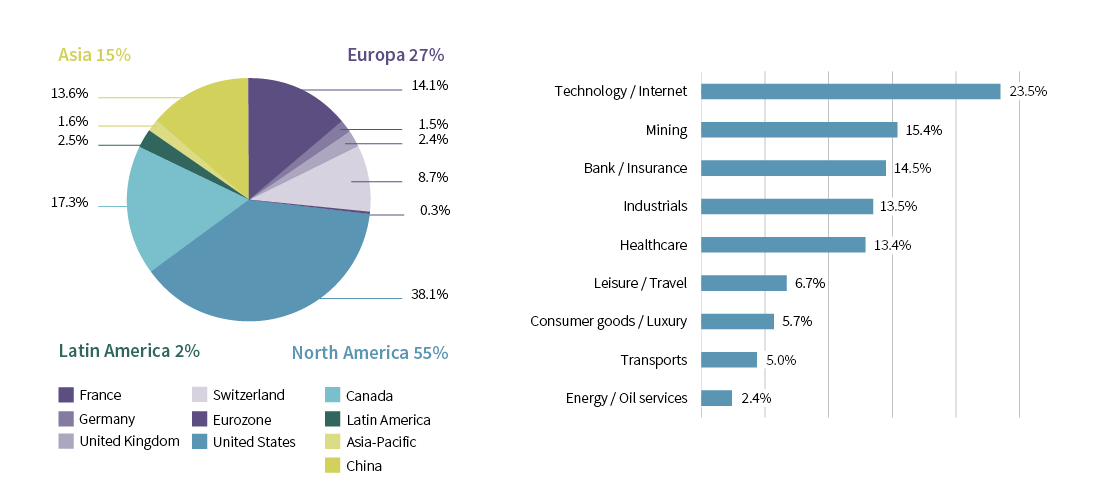
R-co Valor recorded a year-to-date performance of -1.03%(2). Following the first quarter, most of the fund’s relative resilience was the result of the commodities sector’s positive contribution to the portfolio. The latter, already on the rise for the past few months, has undergone a new surge, fuelled by the conflict between Ukraine and Russia, both of which are major exporters of oil, gas, minerals, and also grains. As of the end of March, mining stocks accounted for 15.3% of the fund’s equity exposure and energy stocks for 2.4%. Technology stocks, on the other hand, significantly dragged down the fund’s performance, and the two main sub-categories of the sector, US and Chinese stocks, suffered respectively from rising interest rates in the area and from regulatory uncertainty surrounding ADRs(3). The fund’s net equity exposure was lowered from 86% to 82% during the quarter, via a profit-taking and risk-reduction strategy. Partial and total sales were made, mainly on our diversified mining stocks and on the energy sector. On the other hand, marginal reinforcements were initiated on stocks that had significantly underperformed in the technology, industrial and leisure/services sectors.
Our main geographical exposure remains North America, at 55%, which has been supported so far this year by a flight to quality(4), with US indices back to their pre-invasion levels. With 27% of our equity exposure, Europe is currently paying the price of its direct geographical proximity to the conflict. In the event of a peace agreement, it could offer significant upside potential. And, lastly, China, with 14% of the fund’s equity exposure, appears to have run into a dead-end in its management of Covid-19, although being supported by a government particularly committed to achieving its 5.5% growth target(5), and a central bank committed to cutting its interest rates. The inversion of the US yield curve, a harbinger of a potential recession, is keeping investors on edge. Central banks’ balancing act appears ever riskier in a context where inflation, fuelled by the Russian-Ukrainian conflict, could last over time. The labour market is still tightening, especially in the United States, with unemployment rising to 3.6%(6), underlining the idea of an inflationary spiral induced by rising wages. China, clearly at odds with other regions, is currently struggling with its health situation, and its growth target could be undermined if the situation drags on. The government’s commitment to stimulating its economy nevertheless suggests that support measures can be expected during the year. As far as portfolio transactions are concerned, we remain disciplined, taking profits on stocks that have particularly stood out in recent months and by opportunistically reinforcing stocks that have been excessively penalised by the market.
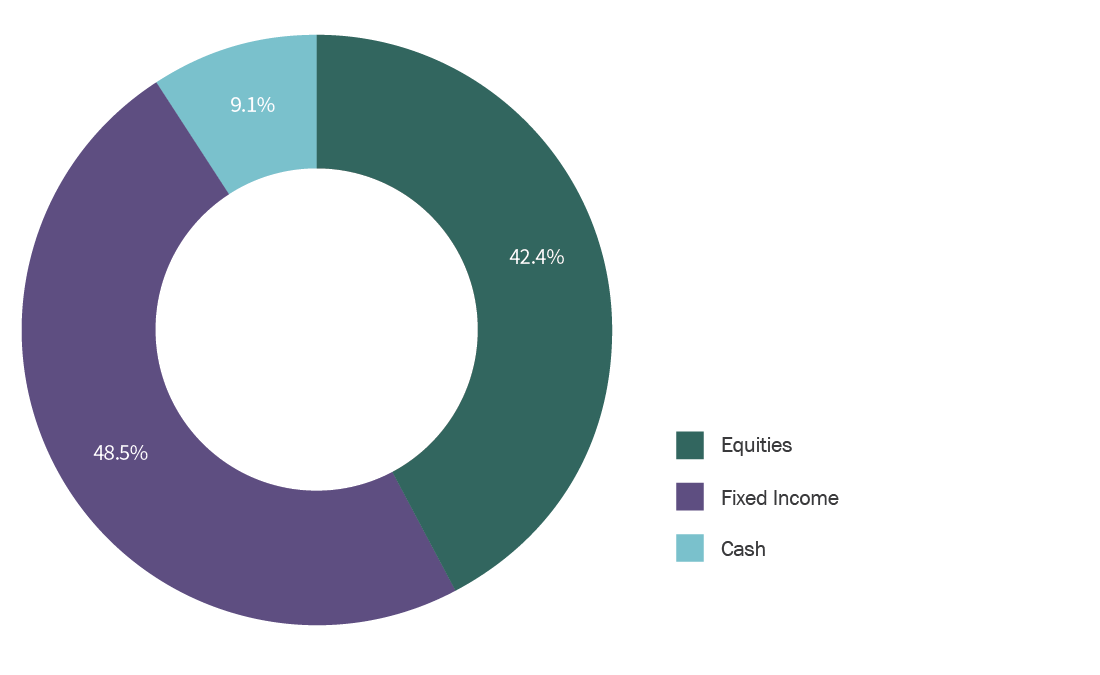
Over the first quarter of the year, the fund’s equity exposure fell to 43%. The bond allocation reached 48% as of the end of March.
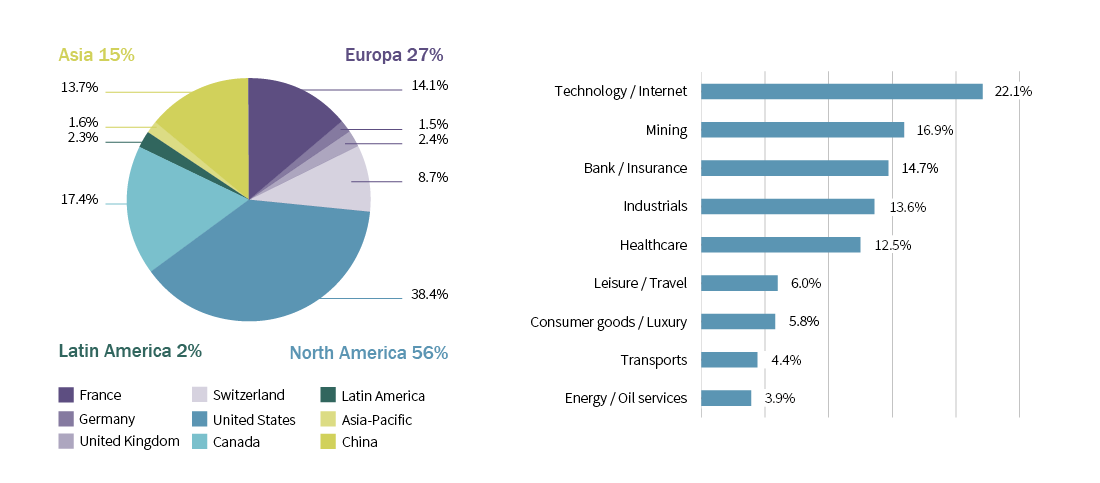
The equity allocation of R-co Valor Balanced replicates the allocation of R-co Valor. Changes made to the two funds and their positions were identical.
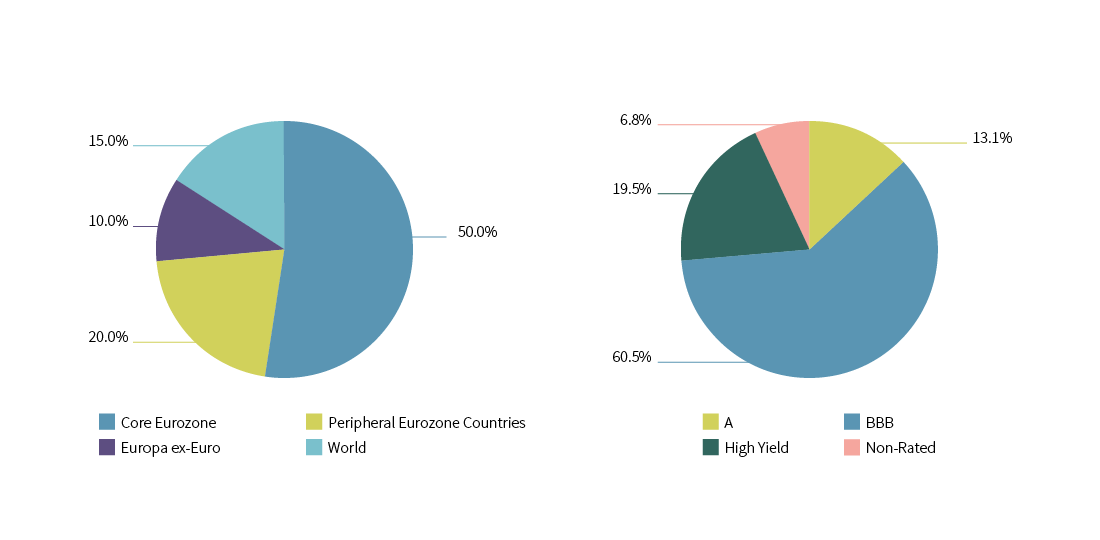
In Europe, the credit market has been hit hard since the beginning of the year, impacted by both rising interest rates and spreads(1) widening. Investment Grade(2) dropped by -5.36% and High Yield(3) by -4,66%, over the quarter, marking the biggest drop since March 2020 in both markets. The upward trend in interest rates, first seen at the beginning of the year, accelerated in March on both sides of the Atlantic. The crisis in Ukraine and the sanctions against Russia have enhanced inflation expectations, especially in Europe, where they have risen by 50 basis points (bps) to reach 2.74% on a 10-year horizon(4). The German Bund 10-year was up by 41 bps to 0.55%(4). In the United States, the Fed announced its first rate hike of 25 bps and also mentioned the terms for reducing its balance sheet. Meanwhile, expectations of a sharp monetary tightening have exacerbated the flattening of the yield curve. While the 10-year rate rose by 51 bps, the 2-year rate increased by 86 bps, and the two closed at the same level of 2.34%(4). The euro credit market has been under pressure since the start of the year, including heavy outflows over the past four weeks. The number of issues on the primary market was well below average, and there was little liquidity on the secondary market, with investors generally staying away from those markets.
Along with the euro credit market, the fund was also impacted during this quarter, mainly due to repricing(5) by investors and central banks that were even less accommodating than expected. As for investments, we seized some purchasing opportunities on both the primary and secondary markets. The prevailing nervousness is providing opportunities, especially for investment grade bonds with attractive yields. As an example, we invested in a Mercialys issue, rated BBB and yielding at 2.5%. High-yield issues from Investment Grade issuers also stood out, such as the AT1 Intesa Sanpaolo issue, with a yield of 6.37%(4). Simultaneously, we initiated sales on short-term bonds with low yields. As with our equity allocation, we are staying conservative with our cash allocation, while opportunistically investing in bonds with strong fundamentals and attractive yields.
Completed on 5 April 2022