
Emmanuel Petit
General Partner, Head of Fixed Income

General Partner, Head of Fixed Income

Fixed Income Portfolio Manager Specialisation: IG Credit IG & Crossover
It is definitely going hard for the bond market. Since the middle of last year, we have experienced a significant correction in the interest rate markets, particularly with sovereign debt and Investment Grade(1) credit, which has amplified the rise in sovereign rates. The correction was 14.1% on the European Investment Grade since the low point in rates last August, compared to 8.3% in March 2020, or 7.6% during the financial crisis of 2008(2). In addition, and this is unusual, the segment underperformed the risk-adjusted high yield market, which fell by the same amount over the period. And June set a new record on the credit market: Investment Grade market posted a -3,57% correction with both rate and credits contributing negatively, with credit in a larger extent.
Since May, there has been a changing narrative from inflation risks to growth risks, as investors grappled with ongoing monetary tightening, the zero-Covid strategy in China, as well as the war between Russia and Ukraine. However, concerns about growth meant that investors began to price a less aggressive pace of monetary tightening from the FED over the coming months. In Europe, continued upside inflation surprises contributed to growing pressures for the ECB to hike rates as early as July. Sovereign bond became again a safe haven asset. In June, the 10-year bund increased from 1,12% to 1,34% with a peak at 1,93% on June 16th(2).
Due to rising interest rates to fight inflation & widening spreads, Investment Grade currently offers an attractive return for the risk taken with levels we did not see any more since 2012. A € Investment Grade portfolio (index) with a 5-year maturity now generates around a 3,7% return, when it was paying just over 0% at the end of the last year. Indeed, the companies in this segment have the necessary resilience to the turbulence that may be experienced, particularly after a period of improving their solvency and liquidity. While in May 2/3 of € IG bonds offered yields above 2%, in June it increased already to 85% of the € IG bond market offering yields higher than 2%.
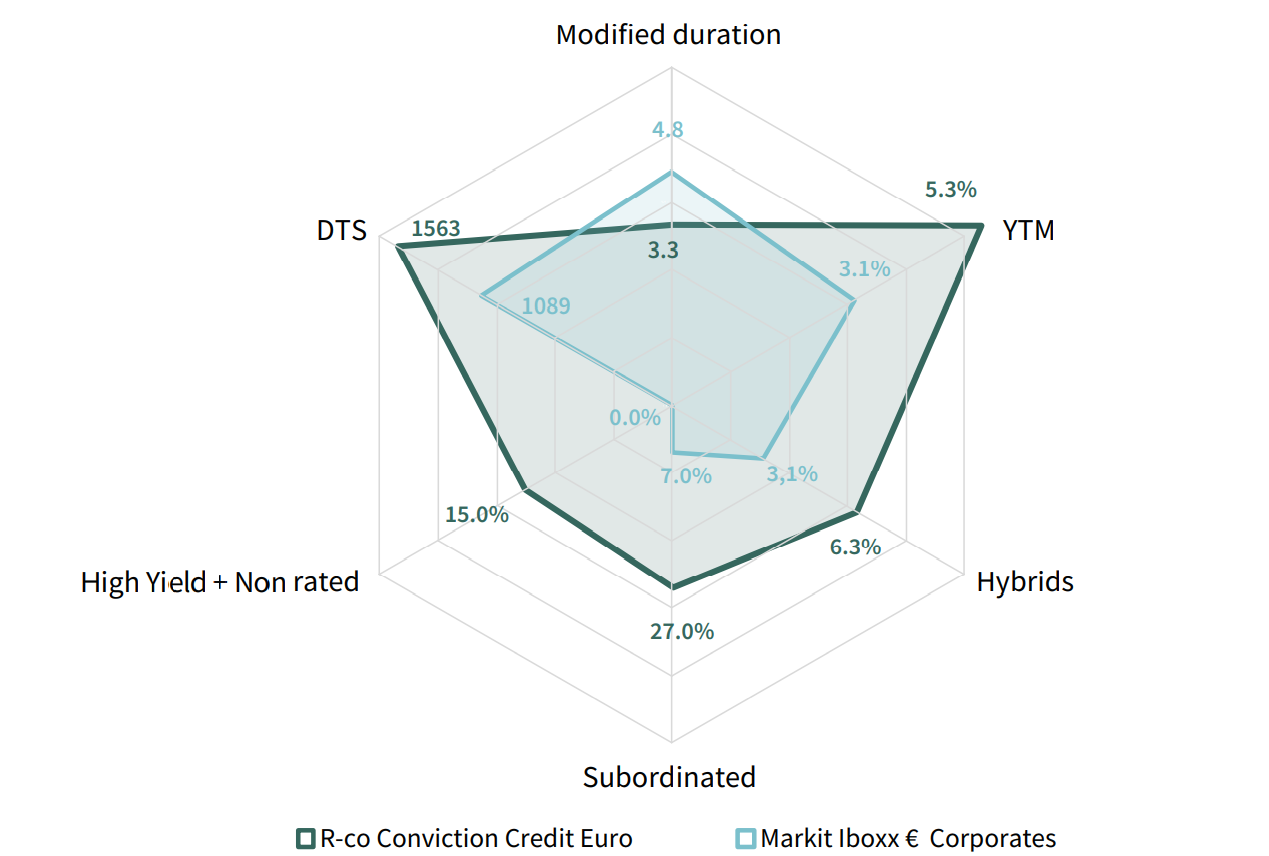
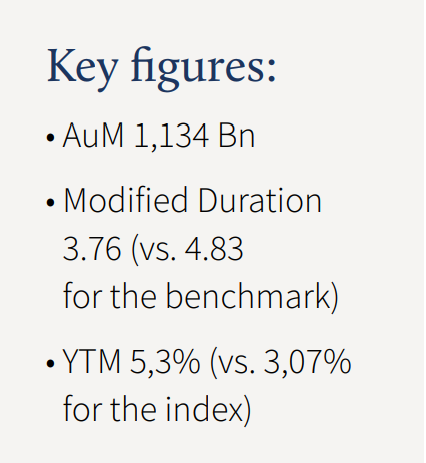
In this context, we decided to lock higher returns on strong names mainly between A and BBB, to build our portfolio with YTM of 5,6% with an modified duration around 3,76. In our opinion, there are currently not many asset classes that give this visibility with this type of yield. Concerning HY, it seems to us a bit early to return to it with the fears on the cycle and potentially rising default rates in the coming months. This is why we have improved the quality of our issuers since the beginning of the year. On IG as well, we remain very selective and are gradually improving the quality of issuers in our portfolio.
H1 2022 key points

Sources: Rothschild & Co Asset Management Europe, 30/06/2022.
In May, rates positioning contributed to the outperformance but credit was costly to the fund, mainly through its NR exposure.June was a difficult month with a 1.17% underperformance mainly linked to the credit risk which was significant in June. Both Alpha(3) and Beta(4) were negative drivers to the fund with Alpha linked to underperformance of high beta such as High Yield (-93bps), Hybrids and the real estate sector (-47bps).

Sources: Rothschild & Co Asset Management Europe, 30/06/2022.
Going forward
We believe that R-co Conviction Credit Euro is a strategy that can take advantage of the current scenario with the following key takeaways:
- Improving the credit quality of the portfolio with a positioning on credit with BBB/BBB- As the Investment Grade market is currently offering attracting yields and the High Yield market is not sufficiently reflecting the risk of a recession, the fund manager is focusing investments on IG bonds (between AAA and BBB-). This move will allow to further improve the quality of the assets of our portfolios as we see the credit cycle move forward very quickly. Currently, 85% of the portfolio is invested in IG, with mainly BBB (64,9%).
- A portfolio construction that allows the fund to perform well in a context of rising rates:
- A conviction management with a high tracking-error (2.4% over 10 years) that allows to generate alpha. Currently, the YTM of the fund is 5,3%.
- A well-diversified portfolio with 206 positions remains important with a quickly changing credit cycle.
Source: Rothschild & Co Asset Management Europe July 2022
(1) Debt securities issued by companies or governments rated between AAA and BBB- on the Standard & Poor’s scale.
(2) Source : Bloomberg, 30/06/2022
(3) Beta is a measure of the volatility—or systematic risk—of a security or portfolio compared to the market as a whole.
(4) A measure of the outperformance of a portfolio, stock or security relative to its theoretical performance. Alpha therefore denotes a manager’s ability to create value by being able to identify stocks or securities that are performing better than they should, taking into account their risk, and this for a given period.


