
Yoann Ignatiew
General Partner, Head of International Equity and Diversified

General Partner, Head of International Equity and Diversified

Global Equities Portfolio Manager
The economy recovered in the first half of the year, driven by a gradual reopening as vaccinations continued to be rolled out. A “return to normal” began to take shape, helped along by the combined actions of central banks and governments, which played their roles to the tilt in supporting the reopening of the economies. In Europe, Christine Lagarde announced an acceleration in the pace of ECB asset purchases, while one stimulus plan after another was adopted in the US, all supported by Joe Biden, even as the issue of how to fund them was already being raised. Government bond yields rose significantly, while the equity markets set new records, driven by massive inflows of liquidity and investors’ relentless optimism.
A new paradigm emerged in the second half of the year, and by the end of the third quarter, the catching-up momentum of the three previous months had vanished. Some central banks raised the prospect of monetary normalisation as inflation seeped into the discussion, dragging the spectre of a potential rate hike in its wake. In the US, political tensions dampened the optimism of market players. In China, the momentum that had begun in 2020 receded, shaken by a tougher line from the Chinese Communist Party, its “zero-Covid” policy, the financial setbacks of Evergrande, and electricity supply issues that hit many regions. Even so, by the end of September, the equity markets had become bullish once again, driven mainly by inflows of liquidity and the inevitable T.I.N.A[1].
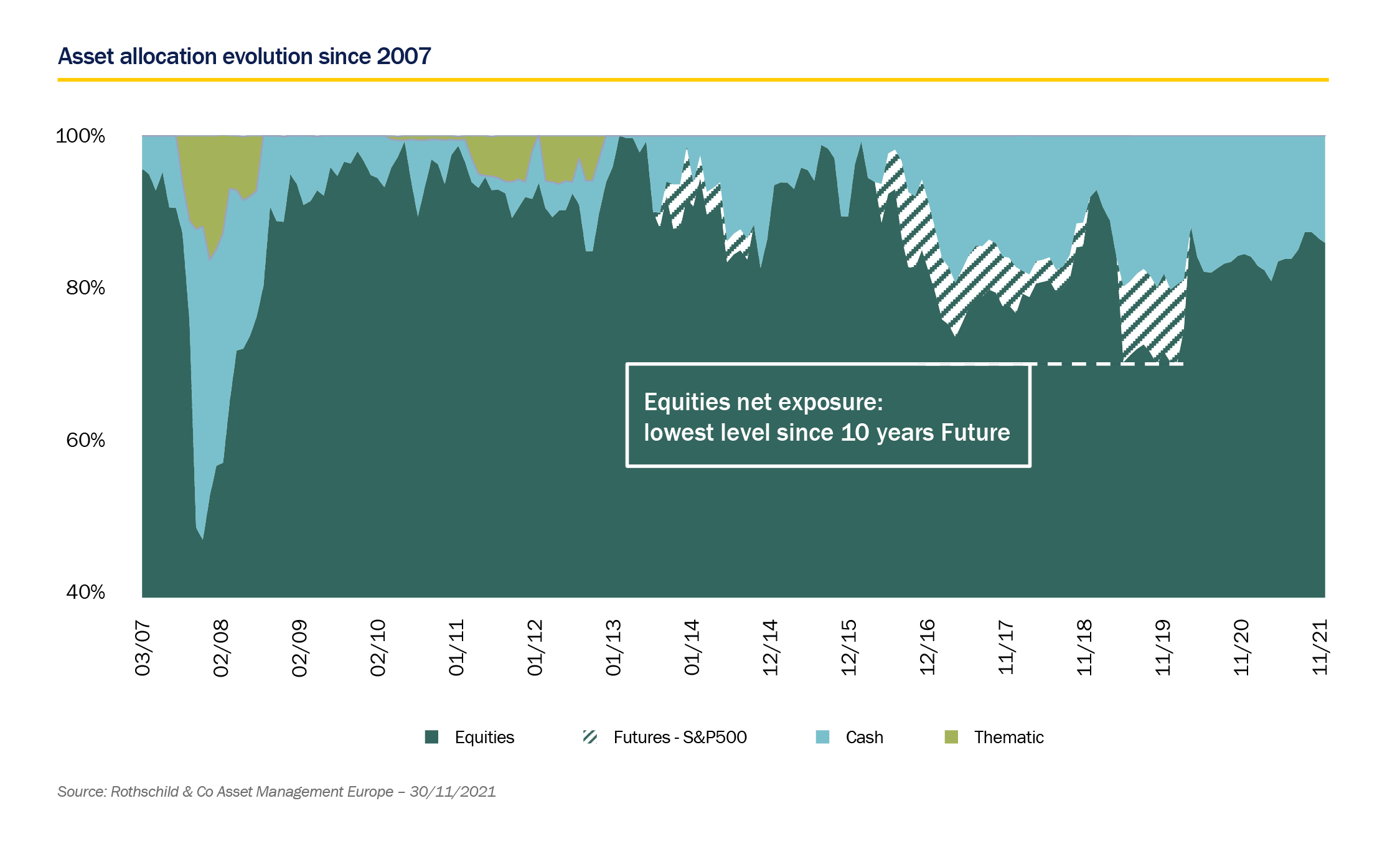
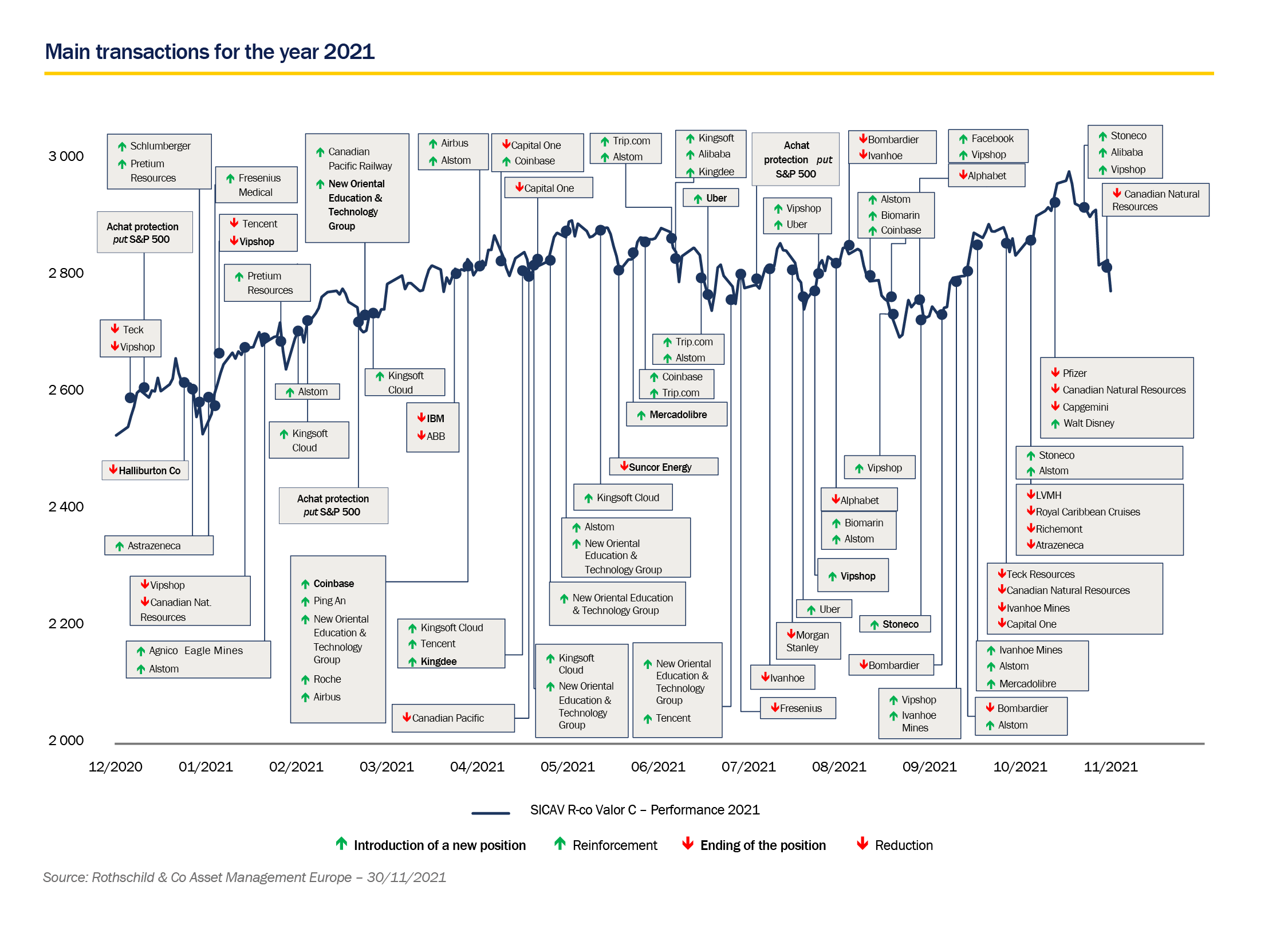
During the year, the fund’s equity exposure ranged from 81% to 88%. The equity markets came in for some aggressive sector rotations into and out of cyclical stocks[2] and growth stocks[3]. Against this backdrop, the fund took profits on cyclical stocks that had rallied the strongest in recent months. The fund sold down, or sold off, some positions, particularly in banking, industrial and commodities. It also added to its growth and defensive exposure through purchases of healthcare and tech stocks. Hedges were set up early in the year via purchases of S&P 500 puts[4].
As 2021 draws to a close, our European exposure is at a 10-year high and reflects our convictions, particularly regarding industrial and healthcare stocks. This looks like the right stance to take given the strong growth being forecast for the coming years, the especially low valuations, and the momentum provided by inflows. Meanwhile, we chose to hold onto our exposure to China by adding to our holdings of some portfolio stocks in mid-year in order to limit dilution in that region. We are confident that, after consolidating its power, the Chinese Communist Party will soften its line. China would then be in a position to move back into its growth trajectory with the likely support of a central bank that has thus far been rather passive. North America is still our main geographical exposure, via the US, as well as Canada. The US government’s huge stimulus plans should provide strong support for the recovery in North America in the coming years.
Within the fund, and in light of inflation uncertainties, we are invested in sectors that are historically resilient. One such sector is industrial companies, which enjoy strong pricing power[5] that is allowing them to preserve their margins. Meanwhile, we are holding onto our exposure to gold mines, which, over time, are a traditional hedge against higher consumer prices and could be driven higher by them. And, lastly, inflation tends to drive up long-term bond yields and could therefore be a driver of banking stocks. The fund’s opportunism and discretionary approach allow us to adjust our investments to market conditions, but we are nonetheless remaining disciplined in our decision-making, taking profits and adding to our exposure to companies having solid fundamentals and that have been hit hard recently. Meanwhile, we possess the necessary leeway to set up hedges via options[6] or futures[7] if that looks like he right move.
As the year draws to a close, a more complex picture appears to be emerging for 2022. Inflation and the normalisation of monetary policies had, until recently, been deemed the major risks, but the pandemic threat, with the emergence of the Omicron variant, must now be counted among these risks. Nevertheless, regarding Omicron, we have to proceed on pure conjecture, given the current lack of information regarding its transmissibility, its virulence and its ability to break through vaccination protection. A worst-case scenario would include the return of lockdowns, paired with a retreat into nationalism and closed borders. On the markets, this would mean switching to a global “risk-off”[8] mode, with a correction in cyclical stocks driven by the reopening of economies, as investors rush nervously into “safe haven” stocks. Central banks, led by the Fed, could also switch gears, downplaying their normalisation process, in order to support their economy. A best-case scenario, however, would assume that the new variant is less dangerous than previously thought, which could provide a boost to equity markets late in the year, with investors pouring back into cyclicals, only some of which have returned to their pre-crisis levels. Meanwhile, central banks could be tempted to head off the risks of uncontrolled inflation through a faster-than-planned normalising of their monetary policies in 2022.
The normalisation of monetary policies, the inflation risk, and the Omicron threat are some of the challenges that will have to be met in 2022. The 900 billion dollars that have flowed into equity funds worldwide in 2021, surpassing the previous 19 years combined, have made investors bullish but no less nervous, and the slightest bad news could trigger a defensive retreat.
All that being said, there are, on the bright side, some factors that seem able to support equity markets in 2022. Some of these are macroeconomic in nature, including global growth forecast at 4.9%[9]. We will also be able to count on ongoing official support from governments via fiscal stimulus, as well as from central banks, which are willing to adjust their monetary policies to the situation at hand. In the US, pent-up demand will remain present, with consumers still sitting on 2300 billion dollars[10] in excess savings.
On top of all this, momentum in flows will continue, including market support provided by share buybacks, which are likely to continue after hitting about 1000 billion dollars in 2021. And, lastly, from a purely microeconomic perspective, earnings growth in 2021[11] will help lower valuations to more reasonable levels. ■
(1) There Is No Alternative: an acronym that refers to the lack of alternative in explaining equity market gains by the dearth of competing investments from the bond markets. Bond yields are said to be so low, with interest rates close to 0%, that they offer no other alternative than to invest in riskier financial assets, such as equities, in order to hope for higher returns.
(2) Cyclical stocks are closely correlated to economic cycles and therefore benefit strongly during recovery and expansion phases but are also the first to be hit by an economic slowdown.
(3) Growth investors focus mainly on potential earnings growth while hoping that the company’s revenue and earnings growth will outperform its sector or the market average.
(4) A sale option entitling its holder to sell an underlying asset on a given date at a pre-determined price.


